Why disks are a hard numerical problem
Protoplanetary disks, accretion disks around black holes and the gas disks of galaxies all need to transport angular momentum outward for gas to accrete. Molecular viscosity is far too weak, so the transport is thought to come from turbulence driven by instabilities, above all the magnetorotational instability (MRI) in sufficiently ionized gas and the gravitational instability in massive, cold disks.
Numerically, the difficulty is that the gas is cold relative to its orbital motion: the rotation is much faster than the sound speed, so the flow is formally highly supersonic. On a static grid this means small time steps and large advection errors as gas streams across the cells. Smoothed particle hydrodynamics avoids advection errors but carries comparatively large intrinsic noise, which can seed spurious instabilities.
In the moving-mesh code AREPO the Voronoi cells move with the gas, which removes the bulk velocity from the time step and lets the resolution follow the density, while fluxes are still computed with a finite-volume scheme. Its weak point was shear: cells are continuously stretched and their faces turn, and it had often been noted that the code lost accuracy in strongly shearing flows. A patch of a Keplerian disk is the extreme case, with shear everywhere and all the time.
Simulating cold shear flows on a moving mesh
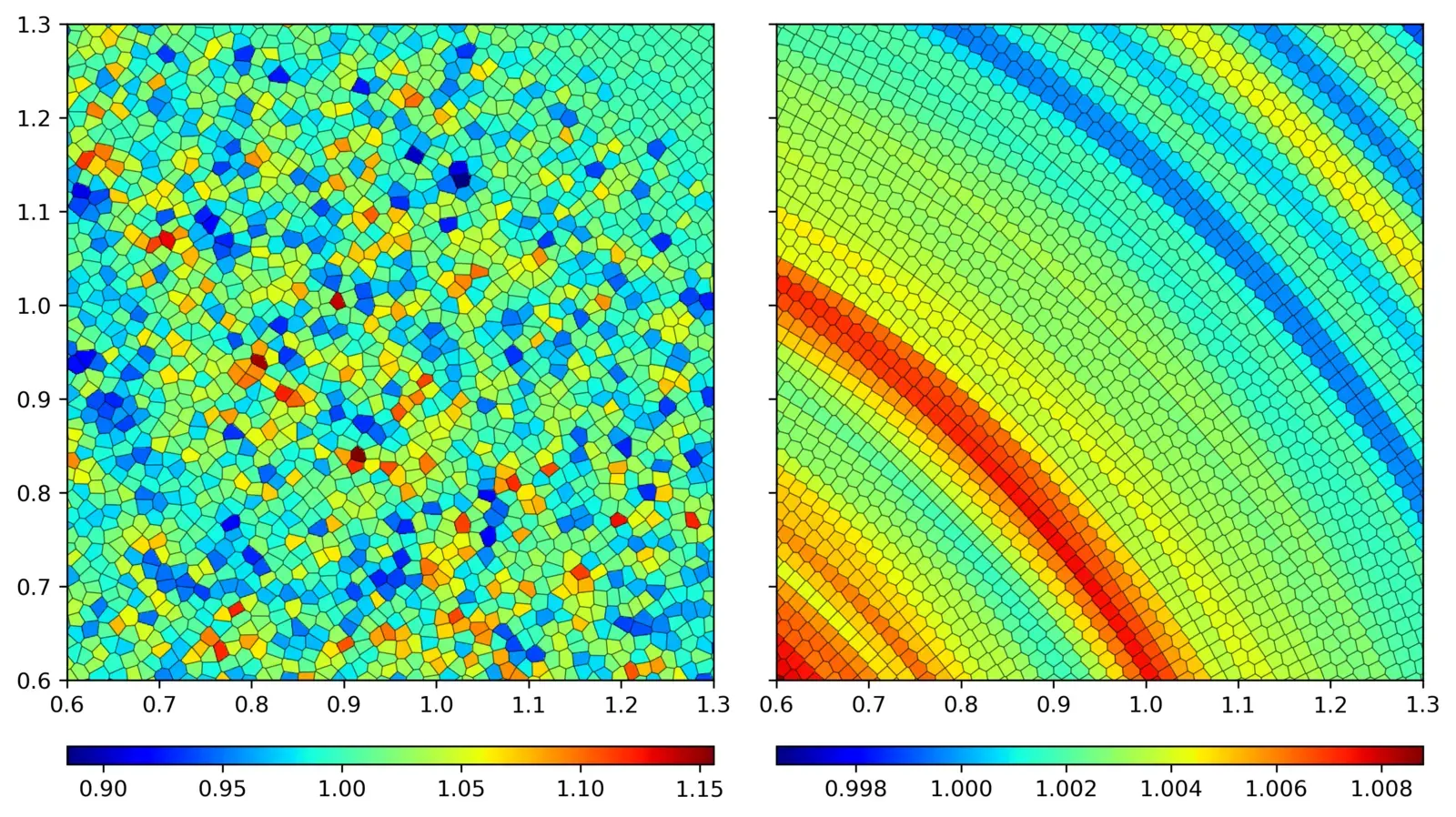
To study disks at high local resolution, I implemented the shearing-box approximation in AREPO with Volker Springel, the first implementation of the shearing box in a moving-mesh code according to the paper. Its simplest test is the ground state, a uniform flow with a linear shear profile, which should stay unchanged. With the default code it did not: density noise at a relative level of about 10−3 appeared and was sheared into stripes. It did not shrink with smaller time steps, and it vanished on static Cartesian or hexagonal meshes, but not once the cells became irregular.
The cause was the flux integral over each cell face. A finite-volume code changes the content of a cell by the fluxes through its faces, and AREPO evaluated each flux once, at the center of the face. This midpoint rule is exact only if the flux varies linearly across the face. With a linear velocity gradient, however, the momentum flux is quadratic in position, and with linear density and velocity gradients the energy flux reaches fourth order. On symmetric cells the resulting errors cancel between opposite faces; on an unstructured mesh they do not, and every distorted cell becomes a small noise source.
The fix is higher-order Gauss–Legendre quadrature over each face. In two dimensions, two evaluation points per face integrate polynomials up to third order exactly, which was sufficient for all tests in the paper. In three dimensions the faces are polygons, so each one is split into triangles taken from the Delaunay tessellation, and each triangle is integrated with four points. Every point needs its own reconstruction of the fluid state and its own Riemann solution, on average more than 15 flux evaluations per face. In a three-dimensional test of the background shear flow, a naive implementation cost about 110 percent more than the single-point scheme; extrapolating the states in time only once per face and vectorizing the flux calculation with AVX-2 instructions reduced this to about 30 percent. In two dimensions the extra cost is small compared with the mesh construction, and the method became the default there.
Smaller changes complete the scheme: a slope limiter that is no longer triggered by smooth gradients on highly irregular cells, a consistent frame for the time extrapolation, and an optional third-order Runge–Kutta integrator. On a static unstructured mesh the ground state is now kept to machine precision. On a freely moving mesh a small residual from the time integration remains, which decreases at second order with the time step.
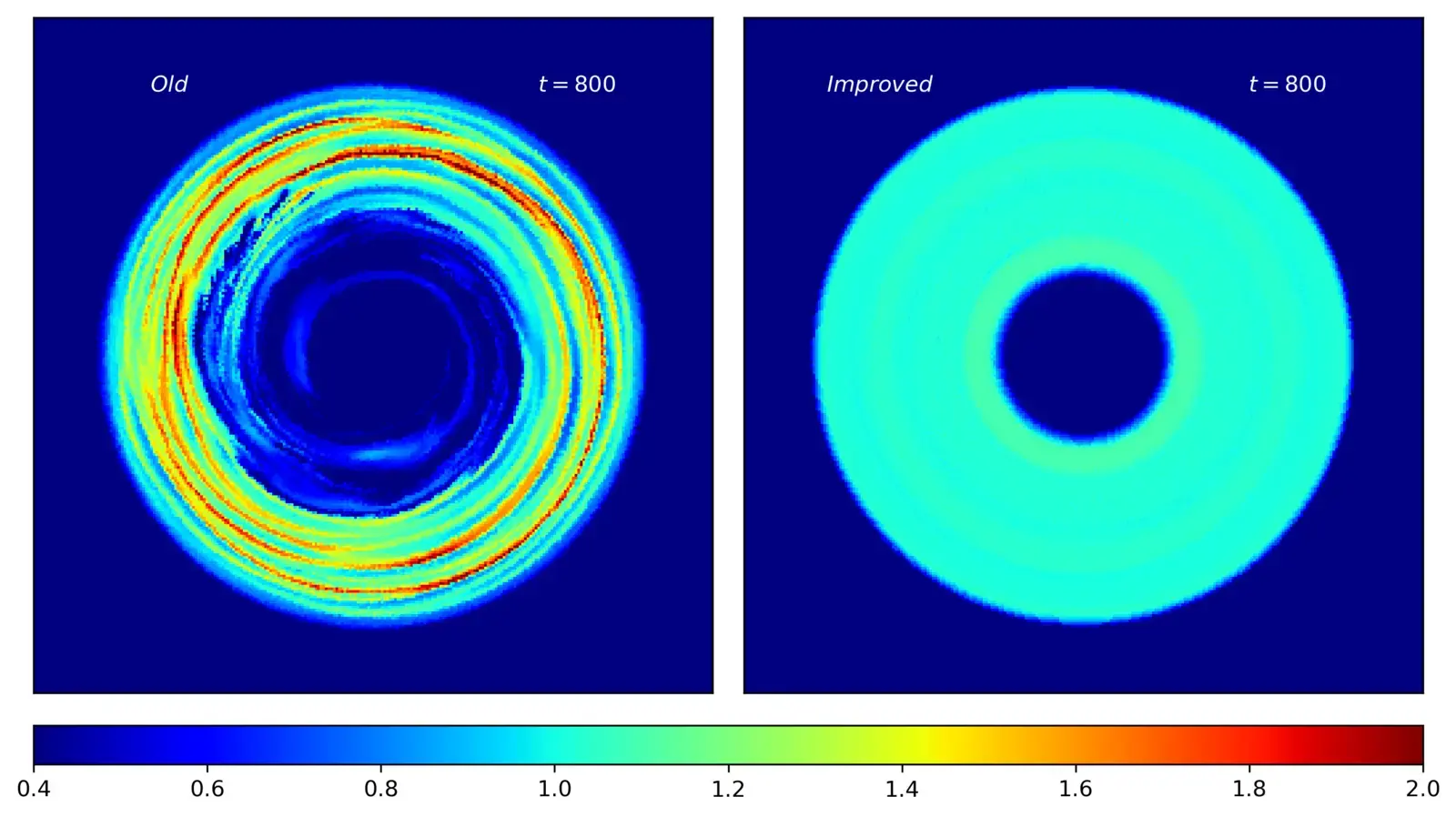
The improvements help wherever shear is strong. In the standard test of a cold gas disk on Keplerian orbits started from a polar grid, the inner edge of the disk begins to break up at about t = 600 with the previous version of AREPO; with the new scheme the disk is still intact at t = 800, whether the initial mesh is polar or Cartesian. The Yee vortex now converges at second order independently of the initial grid. As a first application, AREPO sustained MRI turbulence without a net magnetic field at only 32 cells per scale height, with stresses somewhat below those of the static-grid code ATHENA.
Method pages
Accurate shear flows were the starting point for the rest of this work: the shearing box with its MRI and self-gravity studies, and the non-ideal MHD solver for star formation.
Ohmic resistivity, ambipolar diffusion and the Hall effect on AREPO’s Voronoi mesh, and their application to the collapse of cloud cores into protostars and disks.
Read moreThe shearing-box approximation in AREPO, used to study the magnetorotational instability and the fragmentation of self-gravitating disks.
Read moreStar and disk formation
The non-ideal MHD solver was built for the collapse of dense cloud cores. In ideal MHD, magnetic fields can remove angular momentum so efficiently that rotationally supported disks fail to form, the magnetic-braking catastrophe; in weakly ionized gas, non-ideal effects loosen the coupling between gas and field. With Alexander Mayer and collaborators, we followed this process with AREPO:
- Isolated cores. Across several chemistry models and core geometries, angular momentum is removed significantly less efficiently than in ideal MHD. The Hall effect changes the disk in a way that depends on the field orientation, and can enhance or suppress outflows; in some scenarios it is the dominant non-ideal process (Mayer, Zier et al. 2025).
- The turbulent interstellar medium. In a supernova-driven (256 pc)3 region, resolved down to about 10−4 au in the forming cores, disks of 10–100 au form early without magnetic fields, none exceeds 10 au with ideal MHD, and ambipolar diffusion allows large disks in two of six cores (Mayer et al. 2025).
- Radiation and outflows. With radiative transfer added, a 1 M☉ core is followed to the second Larson core, which launches a jet faster than 10 km s−1 inside a slower outflow from the first core (Mayer et al. 2026).
Earlier, with Andreas Burkert and Christian Alig, I derived an analytic criterion for when the wind of a nearby star triggers the collapse of a pressure-confined Bonnor–Ebert sphere and tested it with SPH simulations; such a wind can lower the smallest unstable core mass to about 0.5 M☉ (Zier, Burkert & Alig 2021).
The methods on these pages formed my doctoral thesis at LMU Munich and the Max Planck Institute for Astrophysics, supervised by Volker Springel, for which I received the Otto Hahn Medal of the Max Planck Society in 2024.
Papers
-
Simulating cold shear flows on a moving mesh
Zier & Springel · MNRAS 515, 525–542 · 2022
The shearing box in AREPO and the higher-order flux integration that removes grid noise in shear flows.
-
Simulating the magnetorotational instability on a moving mesh with the shearing box approximation
Zier & Springel · MNRAS 517, 2639–2658 · 2022
The MRI in unstratified and stratified shearing boxes with net and zero net flux, compared with static-grid and particle codes.
-
Gravito-turbulence in local disc simulations with an adaptive moving mesh
Zier & Springel · MNRAS 520, 3097–3116 · 2023
A TreePM self-gravity solver for the shearing box; gravito-turbulence, the critical cooling time and stochastic fragmentation.
-
Non-ideal magnetohydrodynamics on a moving mesh I: Ohmic and ambipolar diffusion
Zier, Springel & Mayer · MNRAS 527, 1563–1579 · 2024
Ohmic and ambipolar diffusion on the Voronoi mesh with a least-squares gradient estimate at each face.
-
Non-ideal magnetohydrodynamics on a moving mesh II: Hall effect
Zier, Mayer & Springel · MNRAS 527, 8355–8368 · 2024
The Hall effect, its numerical instability at high resolution, and stabilization by a minimum Ohmic resistivity.
-
Moving-mesh non-ideal magnetohydrodynamical simulations of the collapse of cloud cores to protostars
Mayer, Zier, Naab et al. · MNRAS 537, 379–401 · 2025
Collapse of cloud cores with Ohmic, ambipolar and Hall terms and several chemistry models and core geometries.
-
Mayer, Naab, Caselli et al. · MNRAS 543, 3321–3344 · 2025
Protostellar disks forming in a supernova-driven, magnetized interstellar medium, without fields, with ideal MHD and with ambipolar diffusion.
-
Mayer, Pakmor, Naab et al. · MNRAS 545 · 2026
Flux-limited-diffusion radiative transfer in AREPO and the launching of jets from the second Larson core.
-
On the Interaction of a Bonnor–Ebert Sphere with a Stellar Wind
Zier, Burkert & Alig · ApJ 915, 7 · 2021
An analytic criterion for wind-triggered collapse of Bonnor–Ebert spheres, tested with SPH simulations.
-
Ugalino, Diemer, Semenov et al. · submitted to ApJ · 2026
A comparison of Eulerian and Lagrangian MHD codes, including AREPO, for magnetic-field amplification in Milky-Way-like galaxies.