What reionization is
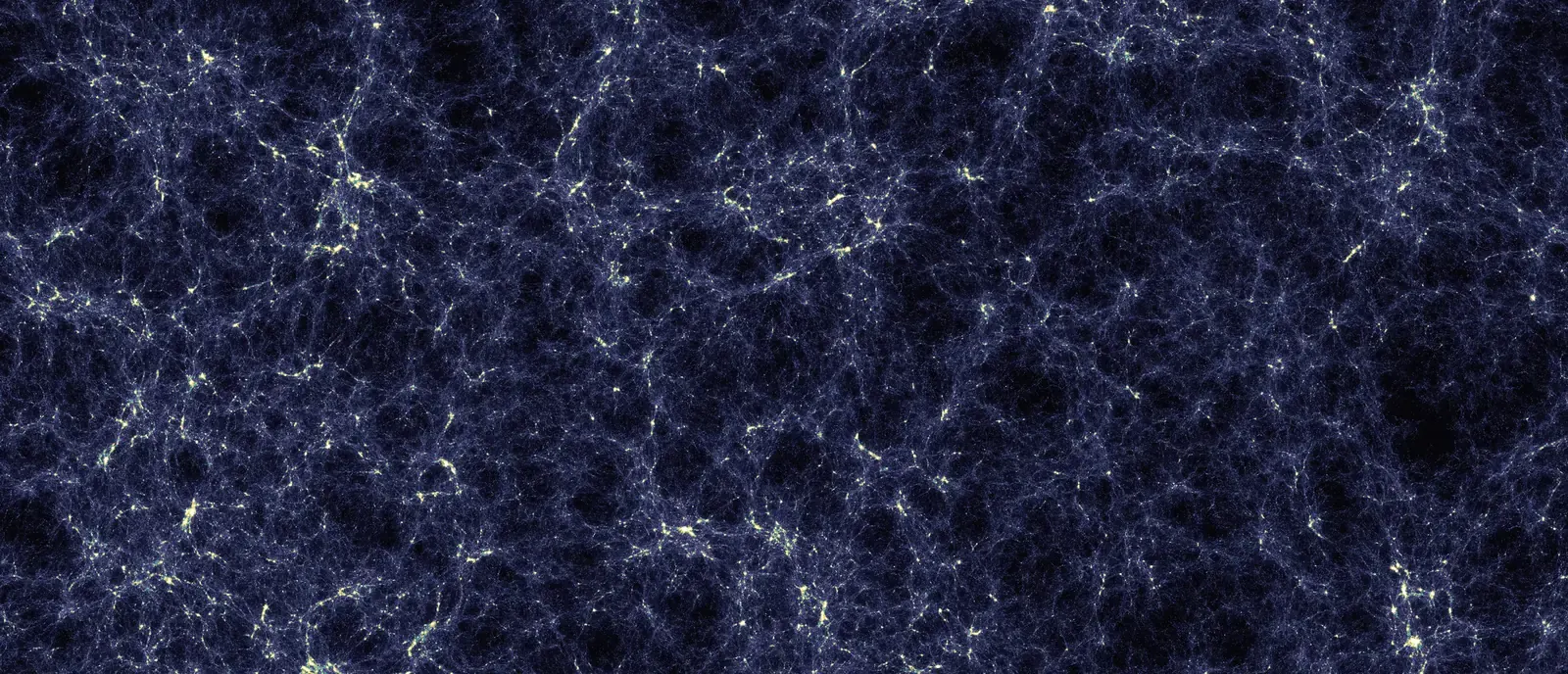
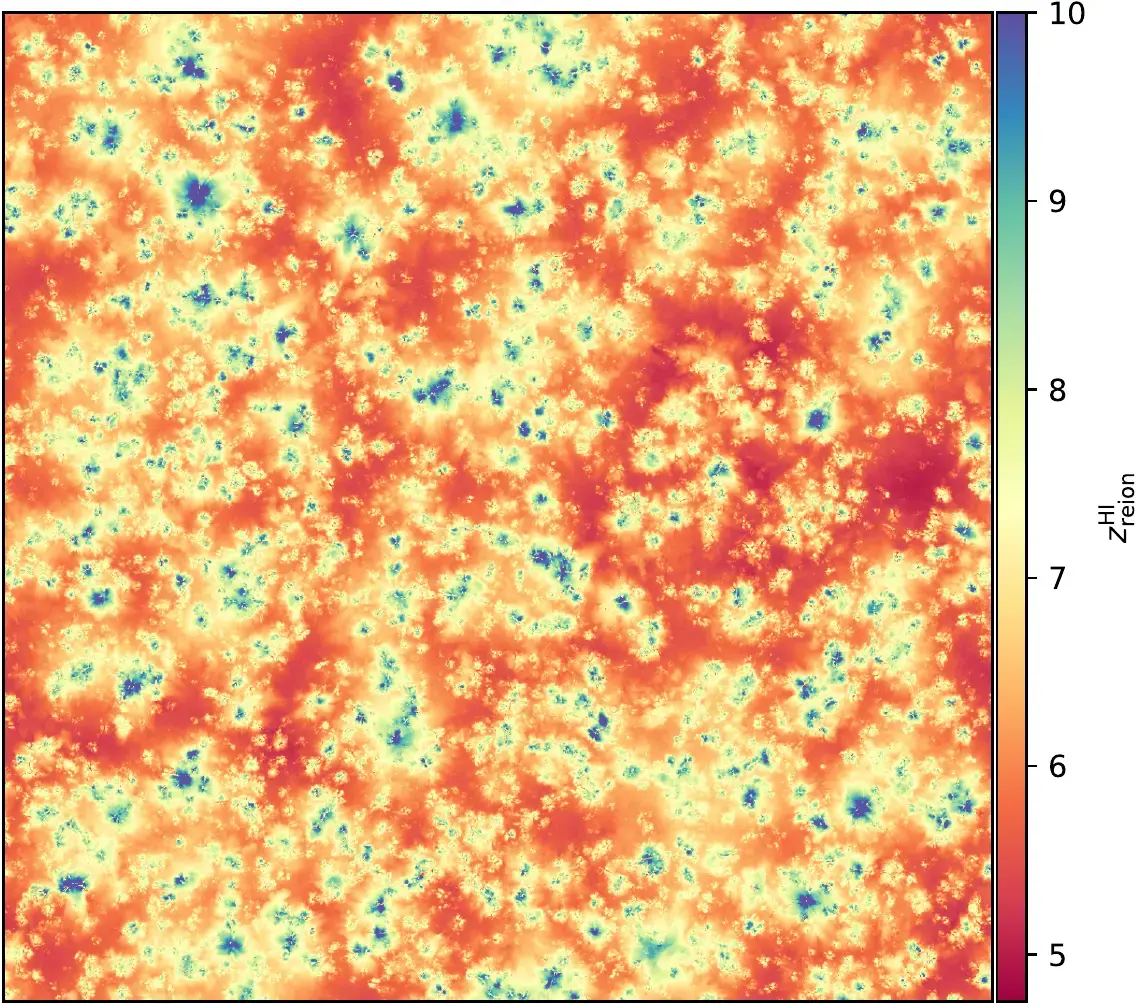
About 380,000 years after the Big Bang (z ≃ 1100), electrons and nuclei recombined and the radiation we now see as the cosmic microwave background (CMB) decoupled from matter. The neutral gas then cooled while dark-matter structures grew, and the first stars and galaxies formed inside them. Their Lyman-continuum photons (energies above 13.6 eV) carved ionized regions into the intergalactic medium (IGM). These regions grew around clustered sources, expanded into the cosmic web and eventually merged, so hydrogen reionization was a patchy, extended process rather than a sudden transition.
Helium has a second chapter. Ionizing He II requires photons above 54.4 eV, and stellar spectra are too soft to do this on cosmological scales. He II reionization is therefore attributed to quasars, whose abundance peaks later; observations place it mainly at 2.7 ≲ z ≲ 4.5. It heats the low-density IGM and leaves an imprint on the temperature–density relation and on the Lyman-α forest.
Reionization matters beyond the IGM: photoheating reduces gas inflow and suppresses star formation in low-mass galaxies, and the timing and topology of ionized regions depend on which galaxies emit and how much of their radiation escapes. The observational constraints are complementary but incomplete:
- Lyman-α absorption toward bright quasars favors a late, extended reionization, with the neutral fraction falling below about 5 percent by z ≃ 5.3–5.8.
- The Thomson optical depth of the CMB (Planck: τ = 0.054 ± 0.007) integrates over the whole history but is only weakly sensitive to its timing and topology.
- The He II Lyman-α forest is observable along few sightlines; many studies rely on fewer than about 25 quasars.
- The redshifted 21 cm line of neutral hydrogen would map the neutral IGM in three dimensions; HERA and LOFAR have so far placed upper limits.
- JWST has found large samples of galaxies in the reionization era, including a surprisingly high abundance of UV-bright galaxies at z ≳ 10.
Why it is hard to simulate
A self-consistent simulation of reionization has to do three things at once: resolve the galaxies that emit ionizing photons and the escape of those photons; transport the radiation so that ionization fronts, photoheating and the hydrodynamic response of the gas are captured; and cover a volume large enough to sample rare objects and average over cosmic variance.
The scales are far apart. In Lumina, the cell size ranges from about 80 ckpc at the mean density to about one physical kpc in star-forming gas, while ionized bubbles grow from about 1 cMpc across at z > 10 to more than 100 cMpc by z < 6. The quasars that drive He II reionization are rare and strongly clustered, which calls for boxes several hundred comoving Mpc across, and converging large-scale 21 cm statistics can require at least 250 cMpc.
Radiation transport is also expensive in itself. An explicit solver must resolve the light crossing time of each cell, roughly Δt ≤ η Δx / c, which is far shorter than the hydrodynamic time step, and the non-equilibrium ionization and heating of the gas must be integrated alongside. A common remedy is the reduced-speed-of-light approximation: both THESAN and Lumina transport radiation at 0.2 c, which reproduces the global reionization history in such setups but can delay ionization fronts in underdense gas late in reionization. Semi-numerical models and radiative transfer in post-processing are much cheaper, but they introduce tunable ingredients or neglect the back-reaction of reionization on galaxies. All previous simulations with on-the-fly radiative transfer end at z ≥ 4.6 and therefore do not reach into He II reionization.
Projects
Lumina is the simulation; the GPU port of AREPO-RT is what made it affordable. Each has its own page.
A 500 cMpc radiation-hydrodynamic simulation that follows hydrogen and helium reionization in one calculation, from the dark ages to z = 3.
Read moreThe GPU port of the radiation-transport solver in AREPO: about 15 times faster radiation transport on standard benchmarks, and the basis of the solver used in Lumina.
Read moreReionization and small galaxies: THESAN-ZOOM
Large boxes cannot resolve the smallest star-forming halos. THESAN-ZOOM addresses them with 14 zoom-in simulations of high-redshift galaxies selected from the THESAN volume, reaching a baryonic mass of 142 M⊙ per cell with a multi-phase model of the interstellar medium. Instead of a uniform UV background, the zooms take the large-scale radiation field from the parent THESAN box, so each region is reionized when and as THESAN predicts. I led two studies within the project.
Population III star formation continues to the end of reionization
Population III stars form from metal-free gas, and their formation rate is expected to drop sharply after z ≈ 15 as earlier generations enrich the gas. Using the 14 zooms, with Lyman–Werner radiation and a non-equilibrium network that tracks molecular hydrogen, we found that Population III stars keep forming in halos of 106–109 M⊙ until the end of reionization at around z = 5. Photoevaporation then shuts these minihalos down, and they merge into larger halos, so Population III remnants end up mainly in satellite galaxies at lower redshift.
Long-term imprints of external reionization
In the companion paper I compared three treatments of the external UV field in seven zoom regions at 1140 M⊙ baryonic resolution: a uniform background switched on at z = 10.6, the same background switched on at z = 5.5, and the default patchy field from THESAN-1. External UV radiation unbinds gas from halos below 109 M⊙ and suppresses their later star formation. With early reionization, minihalos fail to form stars from pristine gas, so the gas later accreted by more massive halos is less enriched, and halos below 1010 M⊙ have lower metallicities at all simulated epochs (z > 3). Self-consistent shielding also allows a cold, low-density gas phase to survive down to z = 3. The practical conclusion is that models emulating metal enrichment in minihalos need, at minimum, spatially inhomogeneous reionization and a non-uniform metallicity floor.
Future work
Reionization predictions depend on cosmology, on the galaxy-formation model and on how radiation propagates through the IGM. The next projects are designed to separate these effects. All of the work below is planned or in development; no results have been published.
Lumina-EDE: reionization in an early-dark-energy cosmology
Early dark energy (EDE) briefly increases the expansion rate before recombination and was proposed to ease the Hubble tension. It also makes structure form earlier. In the Cosmic Rush Hour paper (Shen, Zier et al. 2026), EDE produced UV luminosity and stellar mass functions in excellent agreement with JWST measurements without additional calibration, increased the number density of galactic disks by about 0.5 dex at z ≃ 6–7, and converged to ΛCDM at z ≲ 3.
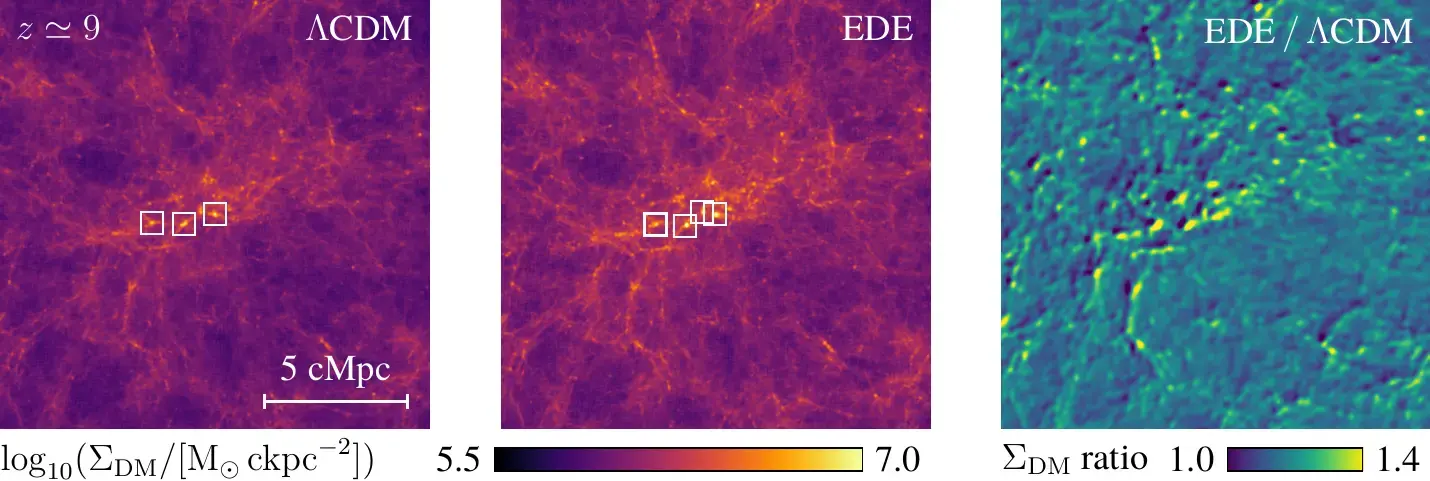
Lumina-EDE is a rerun of Lumina in an EDE cosmology with the same initial phases. Because both runs share the same large-scale structure, differences can be attributed to the cosmology rather than to cosmic variance. I plan to compare the UV luminosity function and clustering of galaxies, the ionized fraction and the sizes of ionized bubbles, and the 21 cm power spectrum and patchy kinetic Sunyaev–Zel'dovich signal between the two cosmologies. Galaxy counts alone are degenerate with star-formation efficiency, dust and luminosity variability; clustering and reionization observables help break these degeneracies. To test robustness, the plan is to vary dust and luminosity variability in the mock observations and the star-formation and escape-fraction prescriptions in smaller volumes.
Radiation transport at the full speed of light
A reduced speed of light can delay ionization fronts in low-density gas, and a moving mesh places its largest cells in exactly those regions; this is also the gas that produces the Lyman-α forest. Keeping a fine grid throughout a large volume, on the other hand, is expensive. I am developing a radiation solver in AREPO that couples a GPU adaptive-mesh grid for the radiation to the moving Voronoi mesh for the gas. This allows transport at the full speed of light and a fixed comoving resolution in the IGM, with further refinement in dense gas, and it provides a basis for implementing more accurate radiation-transport methods. The first application will be to test how the transport approximation and the spatial resolution change reionization predictions, with the high-redshift Lyman-α forest as the target observable.
Public data release
All Lumina data are planned to become public in 2028, and I am leading the release; the Lumina page lists the data products. Some data shown in the papers are already available on the project website.
Papers
Lumina and GPU radiation transport
-
Zier, Smith, Shen et al. · MNRAS 552, stag1469 · 2026
The Lumina simulation: setup, initial conditions, galaxy population, and hydrogen and He II reionization down to z = 3.
-
The Lumina Project: CMB Optical Depth Fluctuations from Patchy Reionization
Smith, Zier, Kannan et al. · submitted to OJAp · 2026
CMB optical depth from light cones through Lumina; patchiness raises it by about 7% over a volume-weighted estimate.
-
Shen, Zier, Smith et al. · submitted · 2026
Multi-band AGN luminosity functions at z ≥ 3, from quasars to little red dots, and the AGN that drive He II reionization.
-
The Lumina Project: Intergalactic Clumping and Recombination Sinks
Sadain, Smith, Zier et al. · The Open Journal of Astrophysics 9 · 2026
Clumping factors and recombination rates across Lumina and THESAN; a near-universal relation in terms of the ionized fraction.
-
The Lumina Project: Morphology of Ionized Bubbles and Neutral Islands
Neyer, Smith, Sadain et al. · submitted to OJAp · 2026
Sizes and shapes of ionized bubbles and late neutral islands, measured with a 3D watershed method.
-
Adapting AREPO-RT for exascale computing: GPU acceleration and efficient communication
Zier, Kannan, Smith et al. · MNRAS 533, 268–286 · 2024
The GPU port of the radiation-transport solver in AREPO.
THESAN, THESAN-ZOOM and related work
-
The THESAN-ZOOM project: Population III star formation continues until the end of reionization
Zier, Kannan, Smith et al. · MNRAS 544, 410–429 · 2025
Population III stars keep forming in halos of 10⁶–10⁹ solar masses until the end of reionization near z = 5.
-
The THESAN-ZOOM project: Long-term imprints of external reionization on galaxy evolution
Zier, Kannan, Smith et al. · MNRAS 544, 391–409 · 2025
How the treatment of the external UV field changes star formation and metal enrichment in halos below 10¹⁰ solar masses.
-
Kannan, Puchwein, Smith et al. · The Open Journal of Astrophysics 8, 153 · 2025
The THESAN-ZOOM suite: zoom-ins of z > 3 galaxies with a multi-phase ISM and the patchy radiation field of THESAN.
-
Summerfield, McClymont, Tacchella et al. · submitted to MNRAS · 2026
Diagnostics of ionizing-photon escape from more than 35,000 THESAN-ZOOM galaxy realizations.
-
Jamieson, Smith, Neyer et al. · MNRAS 541, 1088–1105 · 2025
Growth and merger histories of ionized bubbles in THESAN.
-
High-redshift AGN population in radiation-hydrodynamics simulations
Bulichi, Zier, Smith et al. · MNRAS 544, 355–371 · 2025
AGN at z > 5 in a protocluster with on-the-fly radiative transfer.
-
Shen, Zier, Vogelsberger et al. · MNRAS 550, stag1227 · 2026
Large-scale hydrodynamic simulations of early dark energy and the abundance of bright, massive, disky galaxies seen by JWST.