Overview
Lumina is designed to provide two things in one calculation: enough dynamic range to model the galaxy population that dominates hydrogen reionization, and enough volume to sample the rare, bright quasars that drive He II reionization and the very large ionized regions they produce. The volume also captures the long-wavelength modes that can bias large-scale 21 cm statistics in smaller boxes. The aim is to connect the topology of reionization, the thermal history of the intergalactic medium (IGM) and the demographics of its sources, and to forward-model observables from the epoch of reionization into the post-reionization universe. More is on the project website.
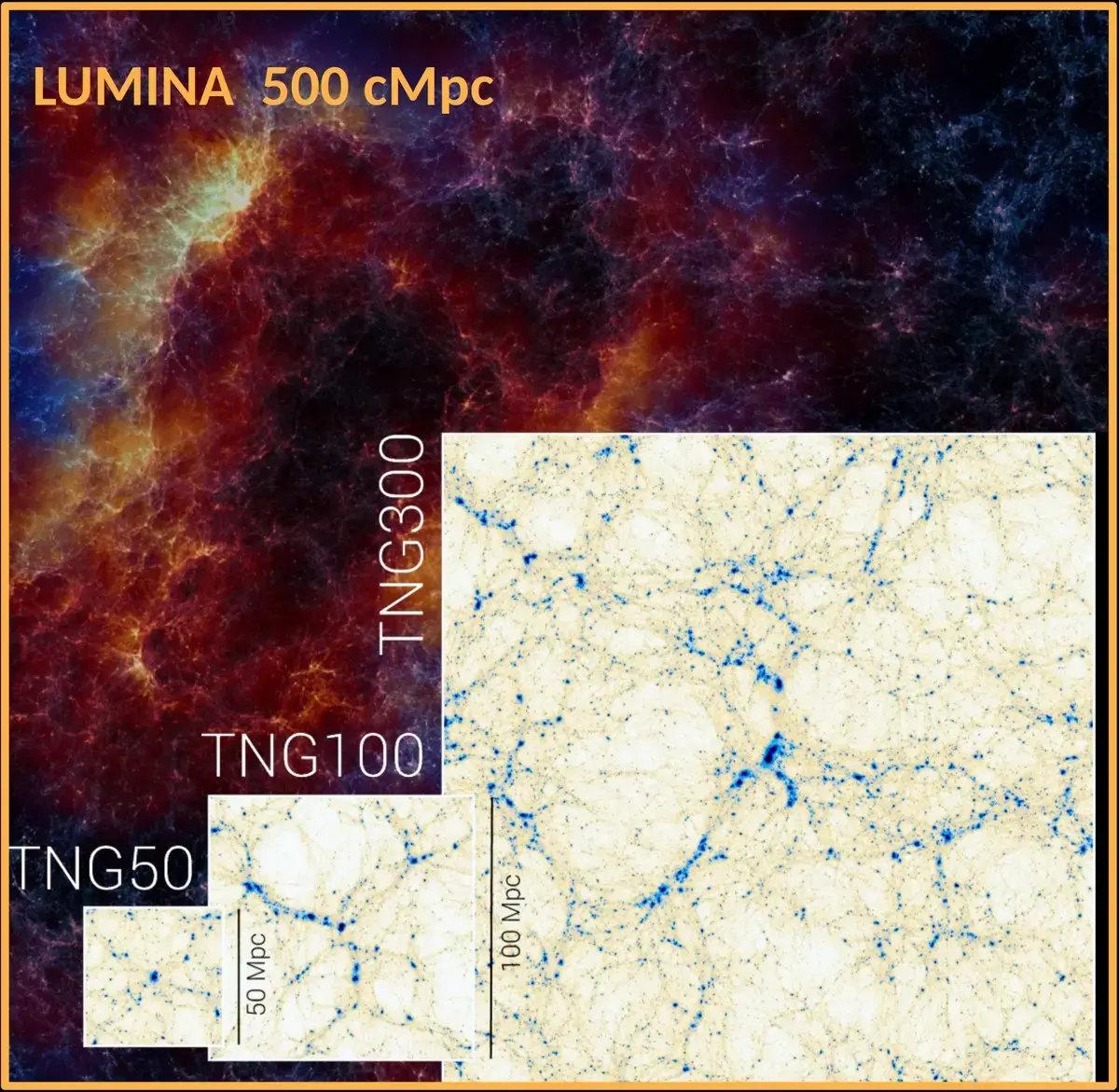
Compared with THESAN, the previous radiation-hydrodynamic simulations with the same family of models, Lumina has about 144 times the volume; its mass resolution is about 6 times coarser than THESAN-1 and 1.3 times finer than THESAN-2. In particle count it is the largest simulation performed with AREPO so far.
A zoom through the simulation
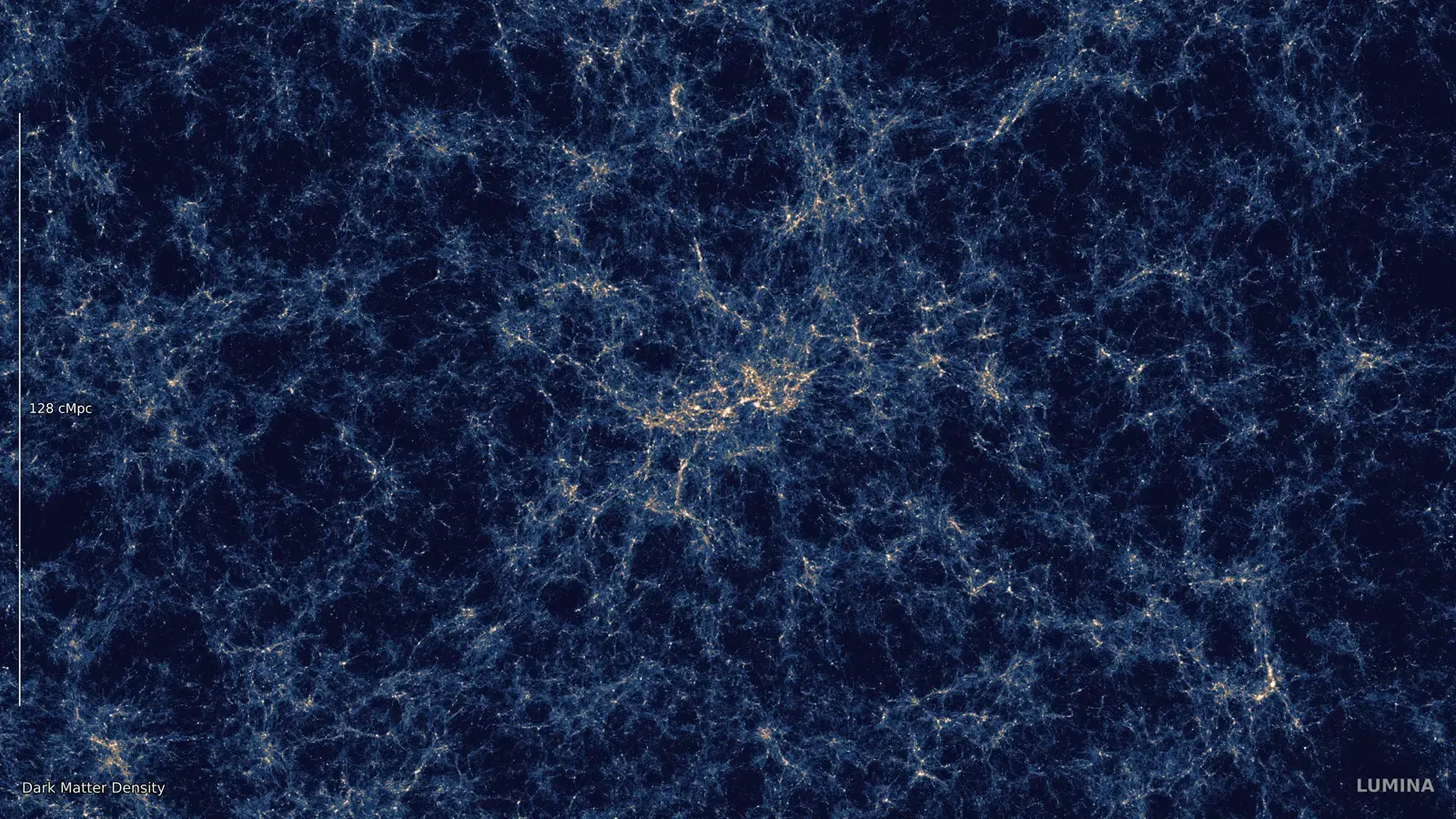
The media gallery of the project site has more movies, including a scan through the volume in eight fields, a fly-through of a massive halo at z = 3, and time-lapse slices of gas density, temperature, and hydrogen and helium reionization, with downloads up to 4K.
The simulation
The numbers below are taken from the introduction paper. Because the mesh moves with the gas, the spatial resolution follows the density, from about 80 ckpc at the mean density to roughly one physical kpc in star-forming gas.
- Box size
- 500 cMpc
- comoving side length (338.3 h−1 cMpc)
- Resolution elements
- 2 × 60003
- gas cells plus dark-matter particles
- Baryonic mass
- 3.6 × 10⁶ M⊙
- target gas-cell mass
- Dark-matter mass
- 1.9 × 10⁷ M⊙
- softening 1.77 ckpc
- Spatial resolution
- ≈ 80 ckpc to ~1 kpc
- cell size from mean density to the star-formation threshold
- Redshift range
- z = 49 → 3
- Planck 2018 cosmology
- Code
- AREPO + GPU AREPO-RT
- moving Voronoi mesh; M1 radiation transport at 0.2 c
- Galaxy formation
- IllustrisTNG
- non-equilibrium H and He chemistry below the star-formation threshold
- Radiation sources
- Stars, AGN, X-ray binaries, hot ISM
- stars and X-ray sources off below z = 4.75
- Frequency bins
- 6, then 1
- 13.6 eV–2 keV in six bins; one He II-ionizing bin below z = 4.75
- Machine
- Frontier
- 1,884 nodes: 105,504 CPU cores and 7,536 AMD MI250X GPUs
- Peak memory
- ≈ 600 TB
- each full checkpoint about 250 TB, written at up to about 800 GB/s
What is new in the setup
Initial conditions with two transfer functions and streaming velocities
Before recombination the baryons are coupled to the photons, so at the start of the simulation their density field is smoother than that of the dark matter, and the two fluids move relative to each other with a coherent "streaming" velocity. Most large cosmological simulations use a single transfer function for both; ASTRID, FLAMINGO and COLIBRE include separate transfer functions but not the streaming velocity. Lumina uses a new initial-conditions scheme that includes both. Following Hahn et al. (2021), both species are first displaced coherently with the total-matter perturbation, the relative density perturbation is then imposed through small variations of the particle masses (at most about 5 percent for the baryons and about 1 percent for the dark matter), and finally the streaming velocities are added. This largely avoids the spurious discreteness forces that otherwise erase the difference between the species. The unperturbed state is a two-component glass in which each species, and their sum, is close to force equilibrium. Gravity is computed at the mesh-generating points so that small-scale baryonic power is not smoothed away early on.
Radiation and the galaxy-formation model
- Transparent star-forming gas. Gas on the IllustrisTNG effective equation of state is treated as optically thin, which gives a clean definition of the stellar escape fraction (fesc = 0.18, calibrated in 100 cMpc boxes) and treats the star-forming gas as in the original IllustrisTNG simulations. THESAN, with a different coupling, used 0.37.
- X-ray sources. High-mass X-ray binaries and shock-heated interstellar gas emit into three X-ray bins that were not present in THESAN and pre-heat the neutral IGM.
- A switch at z = 4.75, the redshift at which the last neutral island in the box disappears. From then on only black holes emit, the four highest bins are merged into one He II-ionizing bin, a uniform UV background replaces transport below 54.4 eV, and the number of radiation subcycles per hydrodynamic step rises from 64 to 256.
- GPU radiation transport. The solver is a further-optimized variant of my GPU port of AREPO-RT, rewritten in AMD HIP for this project. On Frontier it is about 20 times faster than the original CPU solver.
First results
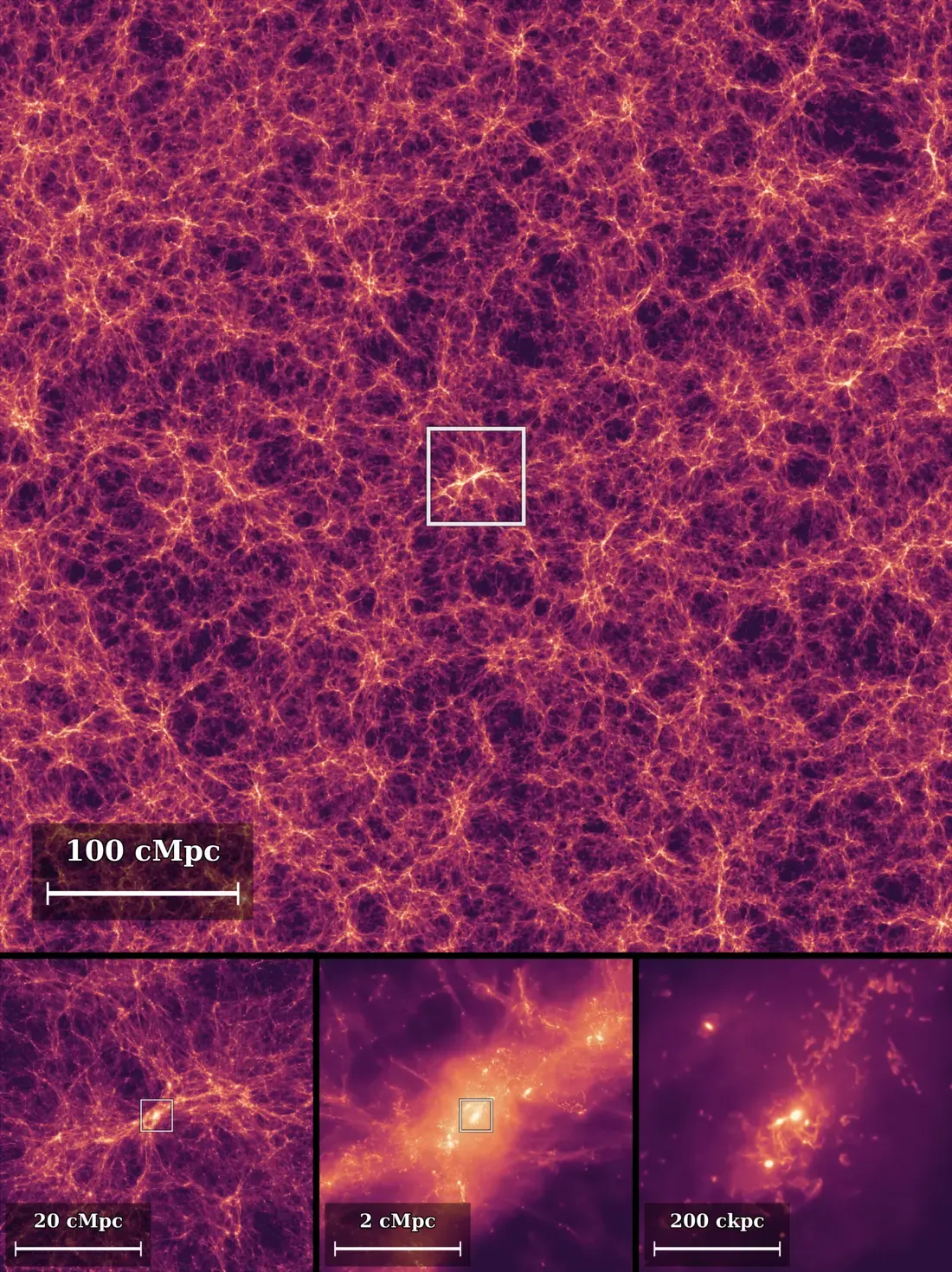
Galaxies. Stellar mass functions, the star-forming main sequence, the mass–metallicity relation and AGN luminosity functions are consistent with IllustrisTNG and broadly with observations. Like other models calibrated at low redshift in ΛCDM, Lumina underpredicts the abundance of the most massive galaxies (M∗ ≳ 1011 M⊙) found by JWST at z ≳ 5.
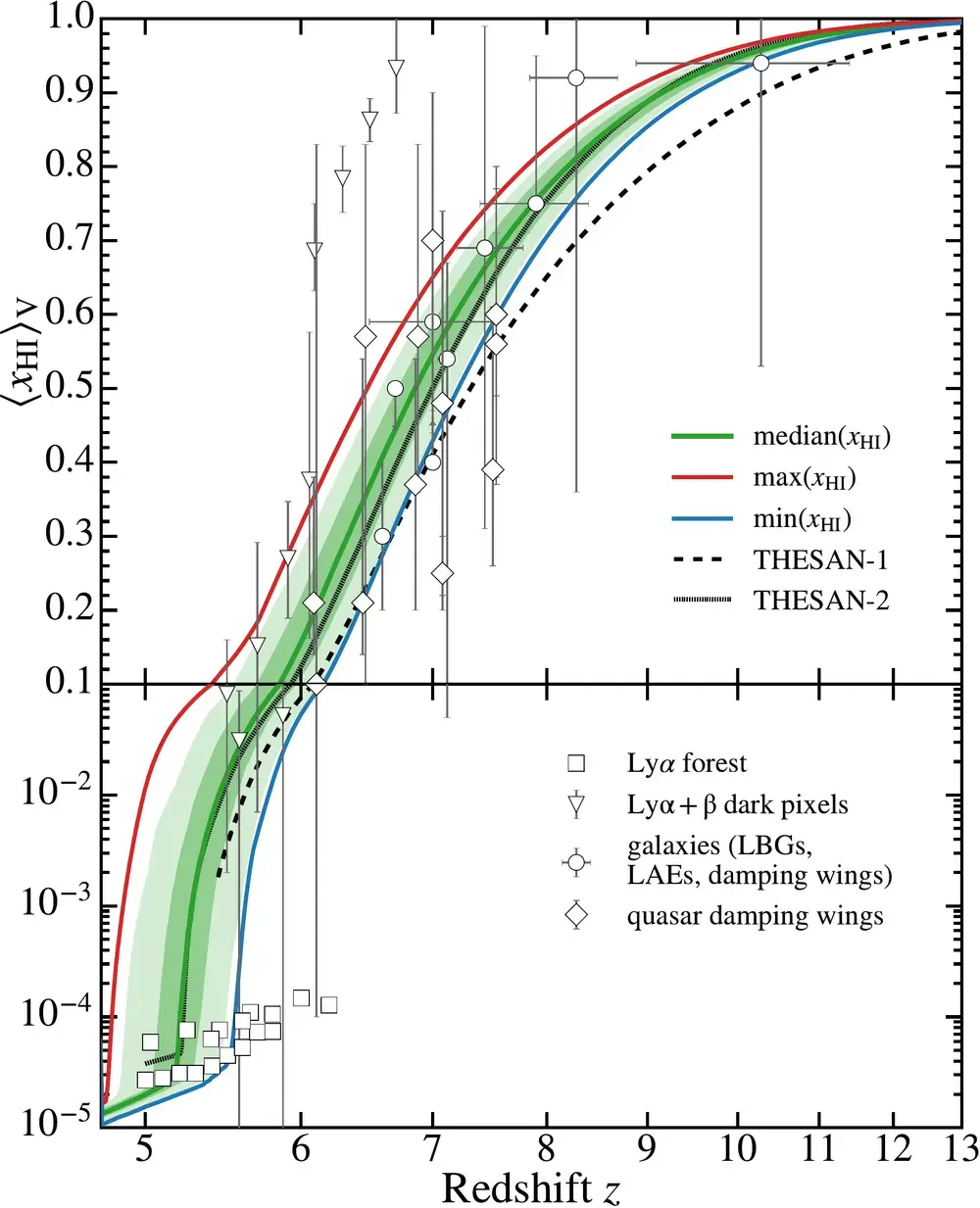
Hydrogen reionization is late and driven by stars; AGN contribute about 14 percent of the hydrogen photoionization rate at z = 5. Split into 125 sub-volumes of 100 cMpc, the median sub-volume is fully ionized by z ≈ 5.2, and the last neutral patches survive until z = 4.75. Part of this late tail may come from the reduced speed of light, which delays the irradiation of remote voids.
Helium reionization is driven by AGN. It starts around z ≃ 6, reaches its midpoint near z ≃ 4, and the median sub-volume drops below 1 percent He II near z ≃ 3, while a few sub-volumes still retain up to about 4 percent. It is faster than most earlier models but consistent with current He II Lyman-α-forest constraints. Its ionized regions are systematically larger than those of hydrogen reionization, reflecting the rarity and luminosity of the sources.
Thermal history. The IGM cools adiabatically, is pre-heated by X-rays, photoheated to 1–2 × 10⁴ K during hydrogen reionization, cools again and is heated a second time by He II reionization. Regions that reionize early in hydrogen also tend to reionize early in helium. In two 50 cMpc test runs, the X-ray sources heat the neutral IGM at mean density to about 2700 K by z = 5.7, compared with about 80 K without them, while the reionization history and the galaxies are essentially unchanged; this matters for 21 cm predictions.
Consistency checks. The Thomson optical depth is consistent with Planck (τ = 0.054 ± 0.007), and the separate transfer functions produce a baryonic power spectrum suppressed by about 10 percent relative to the total matter at z = 10, which Lumina carries forward in agreement with linear theory.
Companion papers
- CMB optical depth. Integrating along light-cone sightlines gives ⟨τ⟩ = 0.0550, about 7 percent above the volume-weighted estimate (0.0515) and close to the mass-weighted one (0.0544), with at least 5 percent scatter between sightlines.
- AGN demographics. Multi-band AGN luminosity functions at z ≥ 3, from hard X-rays to the mid-infrared, with an empirical model that reproduces the abundance and clustering of the little red dots found by JWST.
- Intergalactic clumping. Together with THESAN, clumping follows an approximately universal evolution, at the 10–20 percent level, when expressed in terms of the ionized fraction; a density-only prescription overpredicts the recombination rate by factors of 1.29 at z ≈ 8 and 1.84 at z ≈ 5.
- Bubble morphology. Characteristic bubble radii grow from about 1 cMpc at z > 10 to more than 100 cMpc by z < 6; the residual neutral islands at z < 6 peak near 10 cMpc and are mostly prolate.
-
Zier, Smith, Shen et al. · MNRAS 552, stag1469 · 2026
The introduction paper: methods, initial conditions, galaxy population and the reionization histories.
-
The Lumina Project: CMB Optical Depth Fluctuations from Patchy Reionization
Smith, Zier, Kannan et al. · submitted to OJAp · 2026
Light-cone optical depth and its fluctuations across the sky.
-
Shen, Zier, Smith et al. · submitted · 2026
AGN luminosity functions from quasars to little red dots at z ≥ 3.
-
The Lumina Project: Intergalactic Clumping and Recombination Sinks
Sadain, Smith, Zier et al. · The Open Journal of Astrophysics 9 · 2026
Clumping factors and recombination sinks across Lumina and THESAN.
-
The Lumina Project: Morphology of Ionized Bubbles and Neutral Islands
Neyer, Smith, Sadain et al. · submitted to OJAp · 2026
Sizes and shapes of ionized bubbles and neutral islands.
Data
At about 1.7 TB per single-precision field, Lumina is analyzed largely on the fly. Besides 32 full snapshots from z = 23, repackaged so that each field can be read on its own, the run produced halo catalogs and merger trees, 708 gridded outputs of the IGM between z = 29.4 and 3 at a cadence of a few Myr, a light cone with 51202 rays over 3.6 degrees, 909 black-hole outputs, and power spectra of matter, neutral hydrogen and the ionized fraction. All Lumina data are planned to be public in 2028; some data are already available on the project website.