Why consider self-interactions?
Cold, collisionless dark matter (CDM) describes the large-scale structure of the Universe very well. On the scales of dwarf galaxies, comparisons between gravity-only CDM simulations and observations have raised several possible tensions: the cusp–core problem, the abundance of satellites, the "too big to fail" problem and the diversity of dwarf-galaxy rotation curves. How significant these tensions are is still debated, because baryonic physics, selection effects and the difficulty of inferring halo properties can relieve at least some of them.
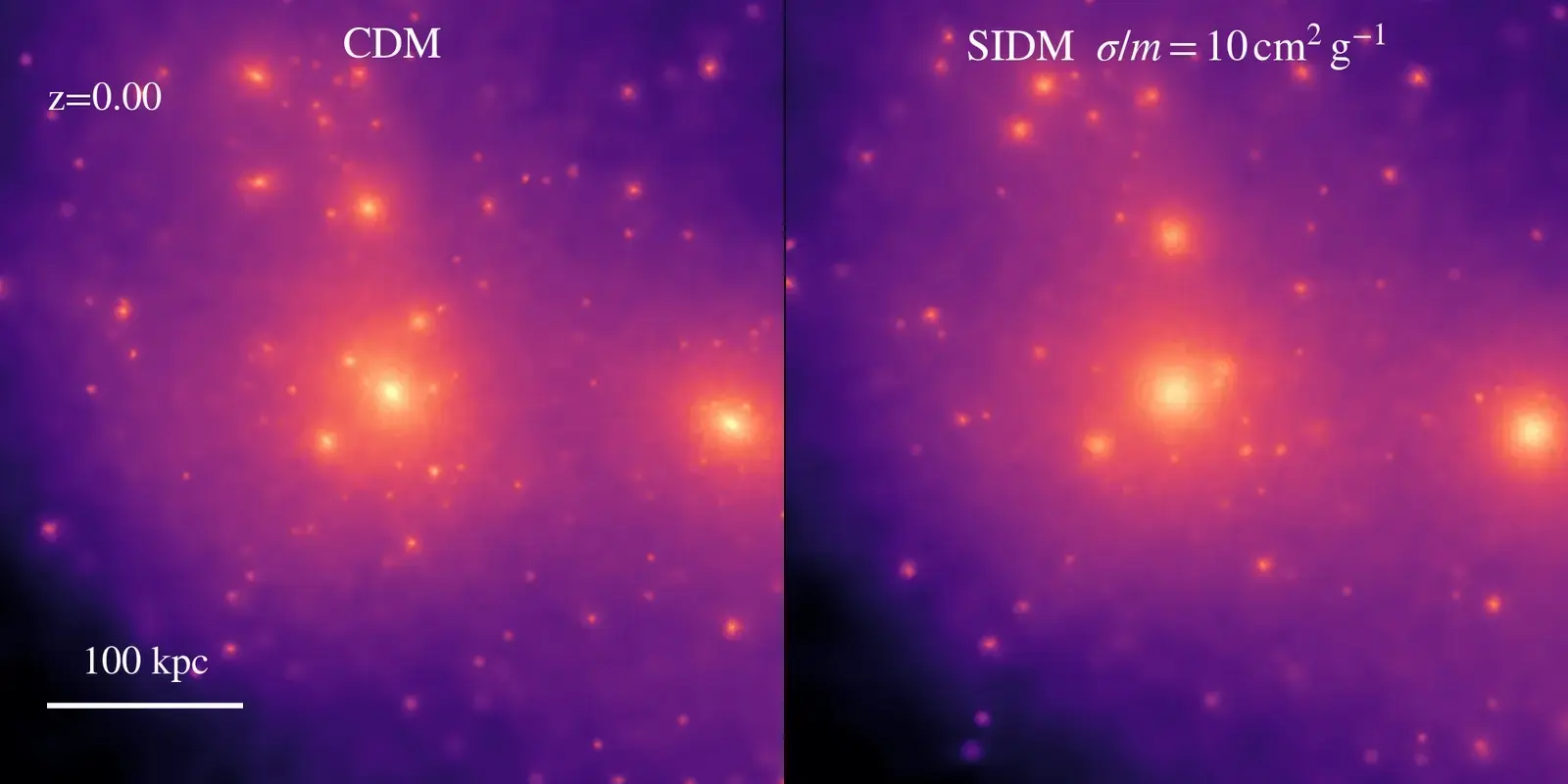
Self-interacting dark matter (SIDM) is one of the most widely studied alternatives (Spergel & Steinhardt 2000). Dark-matter particles can scatter off each other, and the strength of the interaction is set by the cross section per unit mass, σ/m. At the typical velocities of dwarf galaxies, values of roughly 0.1–10 cm2 g−1 produce cores like those observed. Galaxy clusters, where particles move much faster, constrain a constant cross section to considerably smaller values.
This is why the velocity dependence matters. A cross section that is large at the low relative velocities in dwarfs and small at cluster velocities can satisfy both. Such a dependence arises naturally if the interaction is mediated by a light force carrier with a Yukawa-like potential, as in many hidden-sector extensions of the Standard Model. Halo structure then becomes a probe of the microphysics of the dark sector.
What self-interactions do to a halo
Repeated scattering moves energy through a halo and acts as heat conduction. A CDM halo starts with a cusp whose velocity dispersion rises outward, so heat initially flows inward. The center heats up, expands and forms an approximately isothermal, lower-density core.
Core formation is not the end of the story. Once the core is hotter than its surroundings, the heat flux reverses. A self-gravitating system has a negative heat capacity: when the core loses energy, it contracts and heats up further, which drives a runaway known as gravothermal core collapse, first studied in globular clusters. For cross sections of order 10–100 cm2 g−1, the collapse can raise the central densities of dwarf halos a few orders of magnitude above CDM within the age of the Universe.
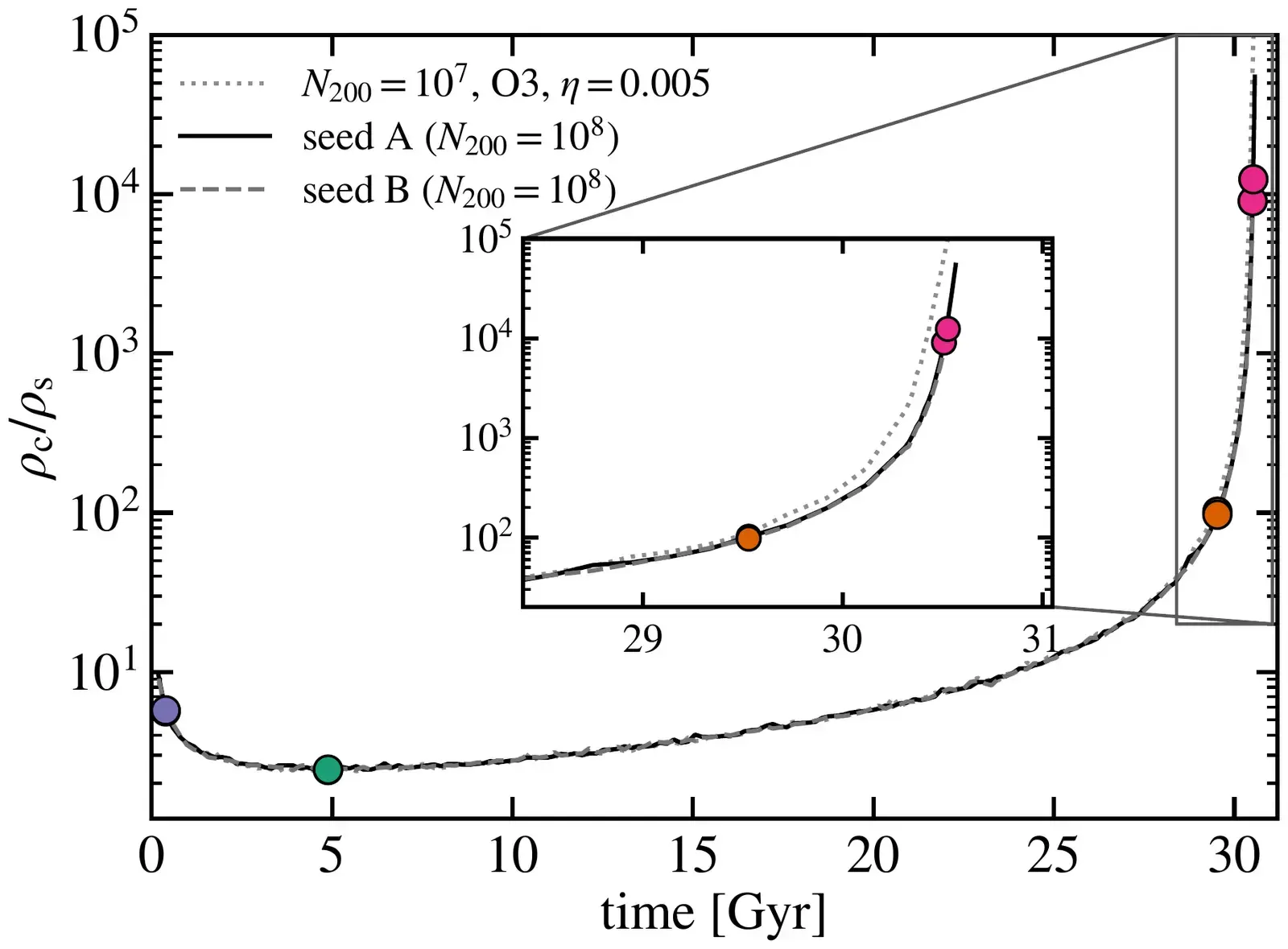
The collapse phase is what makes SIDM interesting beyond the original small-scale problems. Strong gravitational lenses and perturbed cold stellar streams in the Milky Way point to dark substructures that appear denser than CDM predicts at the same mass. Core-collapsed SIDM subhalos are a natural candidate for such perturbers. Collapse in massive halos at high redshift has also been proposed as a route to seeding supermassive black holes. Testing these ideas requires reliable predictions for the late stages of collapse, when the central density rises by several orders of magnitude.
How SIDM is simulated
In principle one would solve the Boltzmann equation with a collision term, but this is far too expensive over the dynamic range of structure formation. The most widely used approach instead adds Monte Carlo scattering to an N-body code. Each simulation particle stands for a patch of phase space, not for a single dark-matter particle. In every time step, each particle i looks at its nearest neighbors j and scatters with each of them with a probability
P(i|j) = ½ mj W(rij, hi) (σ/m) |vi − vj| Δt,
where W is a smoothing kernel of radius hi that weights the pair by its separation rij and Δt is the time step. An accepted pair receives new velocities in its center-of-momentum frame that conserve momentum and, for elastic scattering, kinetic energy. The idea is simple; making it accurate deep in the collapse is not:
- Conservation across processors. In a parallel code, the two partners of a scattering may live on different processors, and one particle can scatter several times in one step. If two events are computed from the same outdated velocity, energy is no longer conserved; if conflicting events are cancelled instead, the scattering rate is underestimated. Both errors grow during collapse, when scattering becomes frequent.
- Time steps. Every pair probability must stay small, so the time step has to shrink with the local collision time. In a dense, collapsing core this limit is far stricter than the gravitational one. Individual time steps save work but can introduce systematic energy errors, and small energy errors change the heat balance and hence the collapse time.
- Resolution. As the core contracts it loses mass, so fewer and fewer particles sample it, and a fixed gravitational softening resolves it less and less well. A scattering kernel larger than the mean free path can also cause spurious heat transport.
My codes
I address these problems with two complementary codes. The SIDM module in AREPO-2 is built for cosmological simulations, with or without baryons, where halos and subhalos form in their full environment. NORI is a GPU-native code for isolated halos that trades generality for speed and reproducibility, so that the late collapse can be followed with many more particles.
A Monte Carlo scattering solver for cosmological simulations with its own dark-matter tree, exact conservation across MPI domains, and velocity-dependent and inelastic models.
Read moreA GPU-native N-body code for self-gravitating, self-interacting dark matter, built to follow isolated halos through gravothermal collapse.
Read morePapers
-
A novel implementation of self-interacting dark matter in AREPO
Zier, Shen, Tran et al. · MNRAS 552, stag1674 · 2026
The SIDM solver in AREPO-2: a dedicated dark-matter neighbor tree, consistent multiple scattering across MPI tasks, and a per-pair time-step criterion.
-
NORI: a GPU-accelerated code for simulating self-gravitating and self-interacting dark matter
Zier, Pakmor, Shen et al. · submitted · 2026
NORI, a CPU and GPU N-body code for isolated SIDM halos, used to follow a halo with 10⁸ particles inside the virial radius to 10⁴ times the NFW scale density.
-
Self-Interacting Dark Matter: From Particle Physics Theories to Structure Formation Simulations
Rosenlyst, Tran, Zier et al. · submitted · 2026
From particle-physics models to simulation inputs, with anisotropic, multi-state, inelastic and dissipative scattering and dark-matter decay implemented in AREPO-2.
-
Role of prompt cusps in driving the core collapse of self-interacting dark matter halos
Tran, Gilman, Delos et al. · PRD 113, 083030 · 2026
Steep prompt cusps at the centers of halos slow the early core-formation phase by a factor of about two.
-
Novel density profile for isothermal cores of dark matter halos
Tran, Shen, Vogelsberger et al. · PRD 113, 063024 · 2026
An analytic density profile for isothermal SIDM cores that describes halos from early thermalization to late core collapse.