At a glance
- Host code
- AREPO-2
- Moving-mesh cosmological code; dark matter only or with full galaxy formation.
- Scattering scheme
- Monte Carlo, pairwise
- One-sided cubic-spline kernel with 32 ± 5 neighbors; a kernel-overlap estimator is also available.
- Cross sections
- Constant or σ(v)/m
- Analytic or tabulated in relative velocity; inelastic scattering through the outgoing relative speed.
- Conservation
- Machine precision
- Momentum and energy of elastic scatterings, including several scatterings of one particle per step across MPI tasks.
- Overhead vs. CDM
- 24–40%
- Dark-matter-only boxes, 2563–10243 particles, σ/m = 1 cm2 g−1; 28% with baryons.
- Extending the physics
- Four functions
- New pairwise interactions without touching the neighbor search or the parallelization.
The module is described in Zier et al. 2026, written with Xuejian Shen, Vinh Tran, Martin Rosenlyst, Mark Vogelsberger and Rongrong Liu. Its tests use isotropic, elastic scattering.
The problem with the previous approach
The earlier SIDM implementation in AREPO (Vogelsberger et al. 2012), used for example in the AIDA-TNG and Lyra simulations, finds scattering partners with the gravity tree, and the decision whether a particle scatters is made locally before its partner is chosen. Our new module is mathematically equivalent, but its implementation addresses two difficulties.
- Multiple scatterings. If particle a is chosen to scatter with b while c is independently chosen to scatter with a, both events start from the same state of a, and applying both would violate momentum and energy conservation. The previous code therefore cancels all events involving such a particle and keeps them rare by requiring the total scattering probability of a particle per step to stay below κ = 2.5 × 10⁻³. During gravothermal collapse, this limit becomes very expensive, and cancelled events undercount the scatterings.
- Coupling to gravity. AREPO-2 integrates gravity hierarchically and builds trees only for the currently active particles, so the gravity tree is not a complete neighbor list at every step. Reusing it for SIDM rules out this optimized gravity scheme, and in simulations with gas every tree walk also has to skip non-dark-matter particles.
Design
A dedicated dark-matter neighbor tree
The new module builds its own distributed octree that contains only dark-matter particles, right after each domain decomposition. Between decompositions, every node stores the minimum and maximum particle coordinates and velocity components, and its bounding box is drifted conservatively with them, so the tree stays valid without a rebuild. The tree is walked for groups of four particles that are adjacent along the Peano–Hilbert curve, which improves cache locality and gives a typical speed-up of about 2.5 over independent walks in our tests. Because scattering no longer depends on the gravity tree, SIDM can run with the hierarchical gravity integration of AREPO-2.
Consistent scattering across MPI tasks
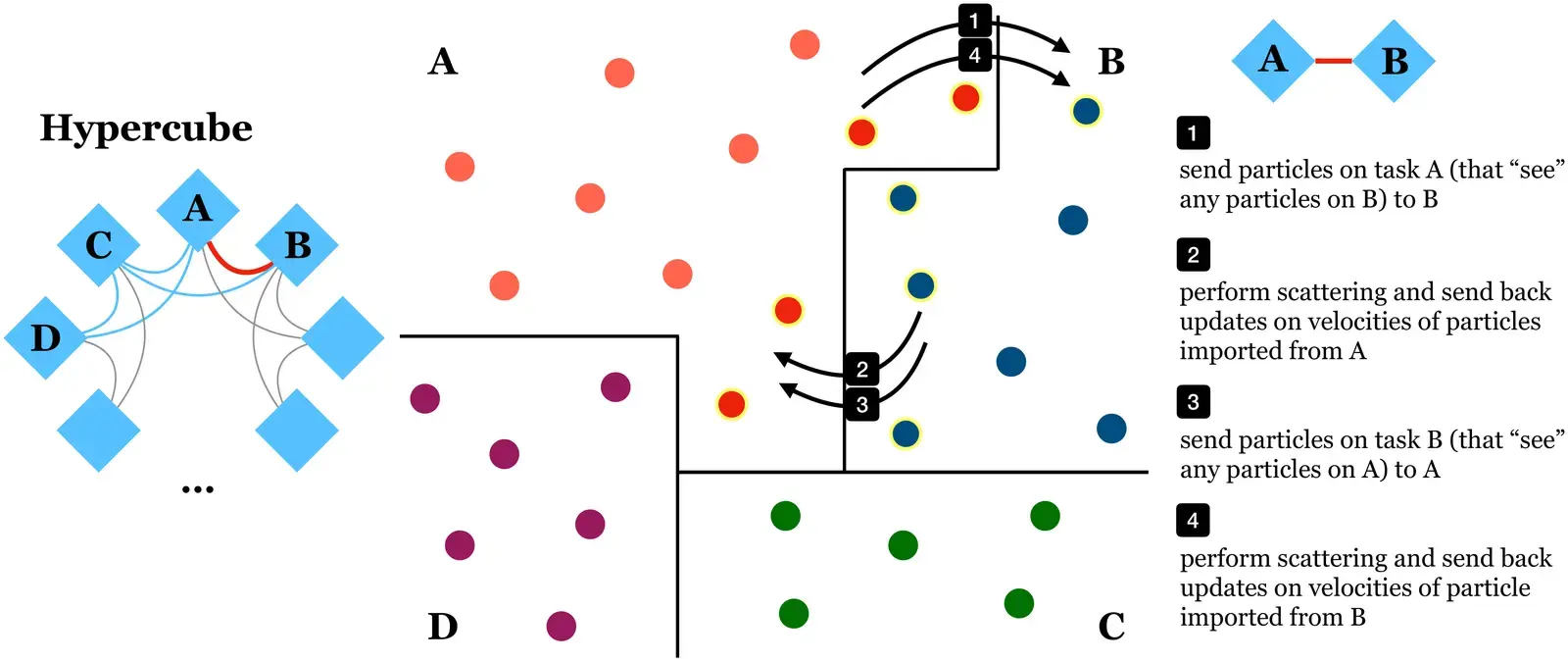
Pairs on the same task are scattered right after the neighbor search, and each accepted event updates both velocities at once, so later events see the new state. Pairs that straddle two tasks are handled by pairing tasks, similar to the scheme of Fischer et al. (2021): one task sends its boundary particles, the other performs the scatterings and returns the velocity updates, and then the roles are swapped. If an imported particle scatters several times, its latest state is reloaded before each event. Only one side of a task pair modifies a particle at any time, so momentum and energy are conserved to machine precision. Each task works through its partners in order of decreasing data volume, which keeps the busiest tasks occupied.
A per-pair time step
Because a particle may now scatter several times per step, the time step only has to keep the probability of each individual pair small, rather than the total probability of a particle:
Δti < CSIDM · 2 / [mDM W(0, hi) (v σ/m)max],
with CSIDM = 0.1, where the denominator bounds the scattering rate of any pair that involves particle i. For typical neighbor velocity distributions, this allows time steps roughly two orders of magnitude longer than the previous total-probability criterion, and since both criteria scale in the same way with density, the advantage persists deep into collapse. In dense collapsing cores the SIDM limit is still stricter than the gravitational one, which is why the late collapse remains the expensive part.
Velocity-dependent and inelastic models
The cross section can be supplied analytically or as a table in relative velocity, interpolated linearly in log velocity for each pair. An accepted pair is kicked in its center-of-momentum frame, and a factor ε on the outgoing relative speed describes inelastic scattering (ε = 1 is elastic). New pairwise physics only requires four functions that perform a scattering and read, write and overwrite a particle's state; the neighbor search and the parallel bookkeeping stay hidden.
Validation
Each test isolates one part of the module:
- Beam through a lattice. 512,000 beam particles cross a static lattice of 803 targets with σ/m = 10 cm2 g−1. The number of unscattered particles decays exponentially at the analytic rate, and the deflection angles follow the isotropic distribution for 16, 32 and 64 neighbors.
- Thermalization in a periodic box. Particles that all start with the same speed relax to a Maxwell–Boltzmann distribution at the rate predicted by a kinetic Boltzmann solver, independently of neighbor number and resolution, for a constant and for a Yukawa-type velocity-dependent cross section. Energy and momentum are conserved to machine precision, even with time steps of several collision times.
- Gravothermal collapse. An isolated 1010 M☉ halo with σ/m = 30 cm2 g−1 and 106 or 107 particles inside the virial radius collapses in agreement with the AREPO-1 implementation and closely tracks a gravothermal fluid model, independently of time-stepping and neighbor-number choices.
- Cosmological runs. Zoom-in simulations of a Milky-Way-mass halo at σ/m = 10 cm2 g−1 agree with AREPO-1 in the host density profile at z = 6 and z = 0 and in the subhalo mass function and radial distribution. In 25 cMpc boxes with 10243 particles, median halo profiles agree with AREPO-1 within the halo-to-halo scatter.
Performance
All benchmarks ran on Intel Sapphire Rapids nodes with 112 cores each on Harvard's Cannon cluster, comparing CDM and the new module in the current AREPO-2 code with the previous SIDM implementation.
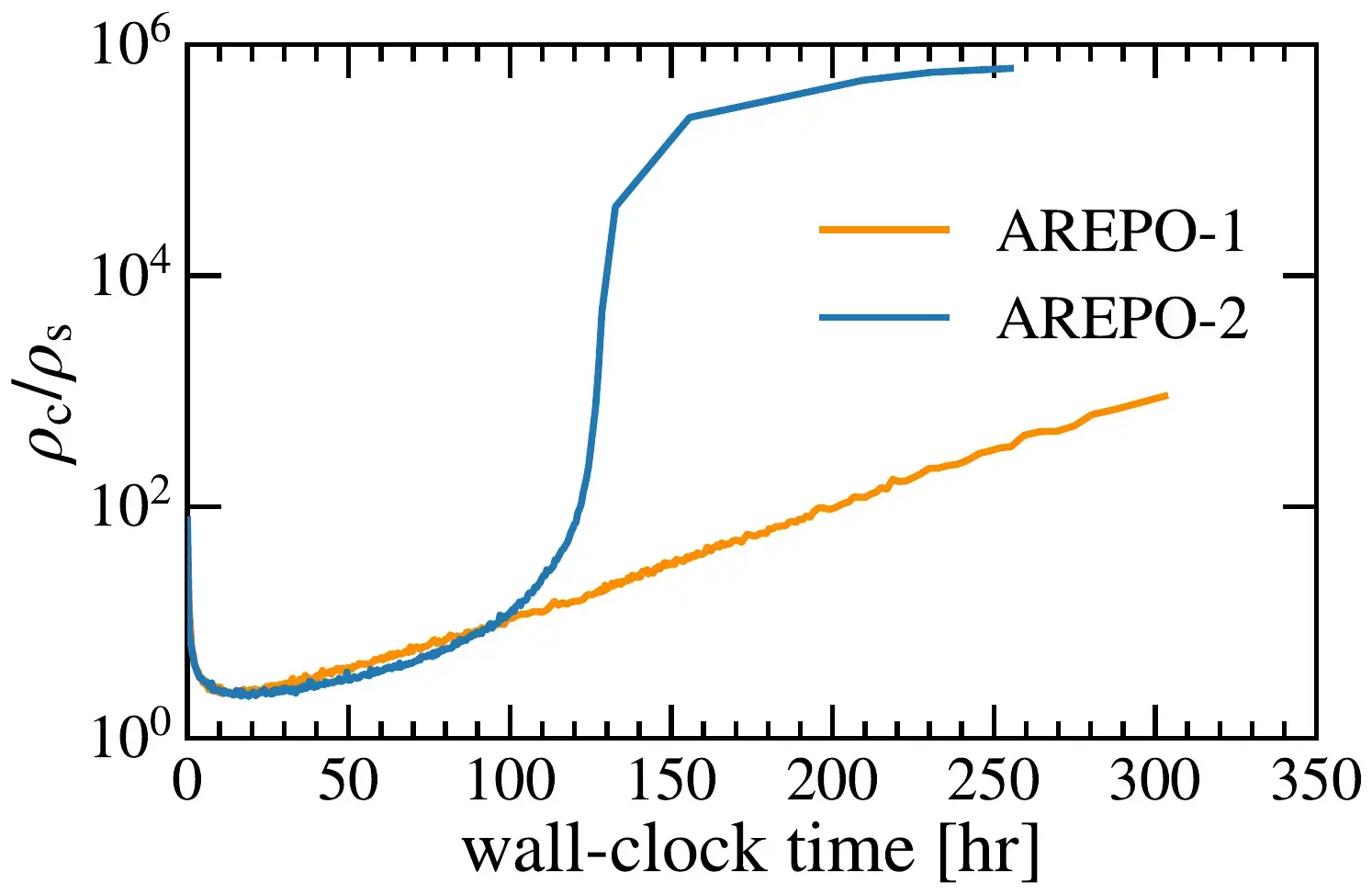
The clearest difference appears in gravothermal collapse. For the isolated halo with 107 particles on one node, the two implementations cost about the same up to the onset of collapse. During the runaway, the new module reaches central densities of about 5 × 10⁵ times the NFW scale density, whereas at comparable cost the previous code reaches only about 103.
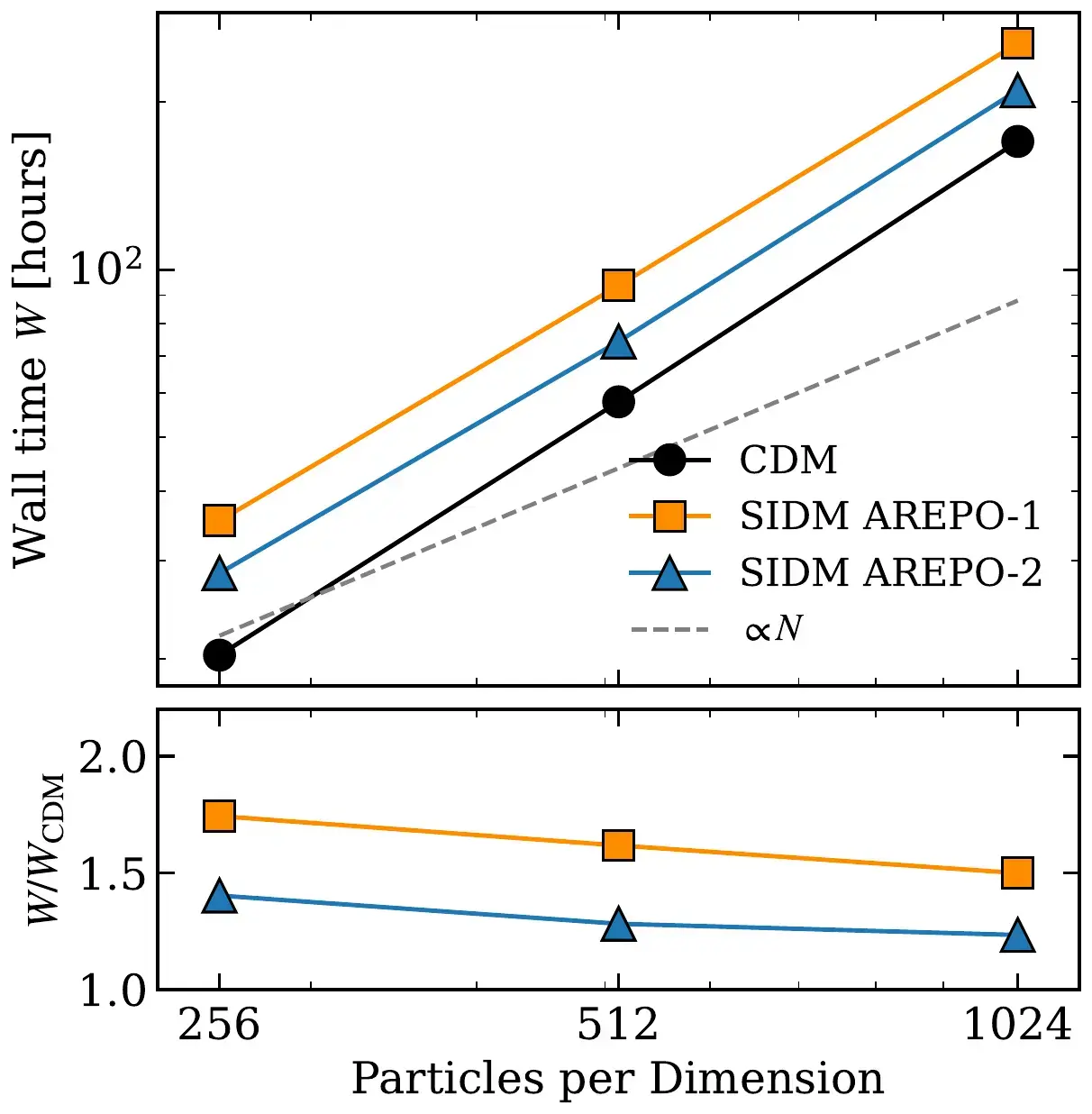
In 25 cMpc cosmological boxes run to z = 0 with a constant cross section of 1 cm2 g−1, where no halo is in the collapse regime, the new module costs 40, 28 and 24 percent more than CDM at 2563, 5123 and 10243 particles. The previous module costs 74, 62 and 50 percent more. The difference here comes mainly from the grouped tree walks. With the velocity-dependent AIDA-TNG cross section at 5123, the overhead is about 37 percent for the new module and 427 percent for the previous one. In a box with 2 × 2563 particles and the IllustrisTNG galaxy-formation model on one node, the new module adds about 28 percent to CDM, while the previous one, which cannot use hierarchical gravity, is about an order of magnitude slower than the new one. The paper notes that this factor depends on the hardware and network.
Uses and extensions
The module is the SIDM solver behind the Milky-Way zoom-in simulations shown on the overview page, and its isolated collapse run is the reference against which we validated NORI. It is also the infrastructure for the extended dark-sector physics in our review with Martin Rosenlyst and collaborators, which adds anisotropic scattering, multi-state and inelastic reactions, dissipative scattering and dark-matter decay to AREPO-2.
Paper
-
A novel implementation of self-interacting dark matter in AREPO
Zier, Shen, Tran et al. · MNRAS 552, stag1674 · 2026
Method, validation and performance of the SIDM module described on this page.
-
Self-Interacting Dark Matter: From Particle Physics Theories to Structure Formation Simulations
Rosenlyst, Tran, Zier et al. · submitted · 2026
Builds on this module to implement anisotropic, multi-state, inelastic and dissipative scattering and dark-matter decay.