At a glance
- Host code
- AREPO
- Moving Voronoi mesh; single-fluid non-ideal MHD, operator-split from the ideal MHD update.
- Effects
- Ohmic, ambipolar, Hall
- Constant or parameterized coefficients in the method papers; chemistry-based coefficients in the applications.
- Gradients
- Least squares per face
- One over-determined fit at each face center; finite-difference fallback for fewer than 0.5% of faces in the tests of paper I.
- Time integration
- Explicit, local steps
- Δt ∝ Δx2/η; no super-time-stepping or subcycling in the method papers.
- Hall stabilization
- |ηH| < 5 (ηO + ηA)
- Ohmic resistivity raised locally where needed; C-shock runs became unstable below ηO/ηH ≈ 0.1.
- Reference code
- ATHENA++
- Comparable accuracy in diffusion, C-shock, Alfvén-wave and linear MRI tests, except post-shock density noise in the adiabatic C-shock.
The solver is described in two papers written with Volker Springel and Alexander Mayer: paper I for Ohmic and ambipolar diffusion and paper II for the Hall effect.
Beyond ideal MHD
Ideal MHD assumes that field lines move with the gas. In cold, dense gas with a low ionization fraction, charged species and neutrals drift relative to each other. Treated as a single fluid, the induction equation then gains three terms:
∂B/∂t = ∇ × [ v × B − ηO J − ηH J × b + ηA (J × b) × b ],
with the current J = ∇ × B, the field direction b = B/|B|, and coefficients that depend on the local chemistry and field strength.
- Ohmic resistivity comes from collisions of charged particles, in weakly ionized gas mainly of electrons with neutrals. It lets the field diffuse and allows reconnection.
- Ambipolar diffusion comes from the drift between ions and neutrals. It is also diffusive but acts only on currents perpendicular to the field, and lets neutral gas slip through it.
- The Hall effect appears when ions decouple from the field while electrons remain tied to it. It is dispersive rather than diffusive: it adds whistler and ion-cyclotron waves, and its sign can change, so its influence depends on whether the field and the rotation axis are aligned or anti-aligned.
The collapse of a protostellar core is the prototypical case: in ideal MHD the rotating core loses angular momentum so efficiently that rotationally supported disks may not form, the magnetic-braking catastrophe, and the non-ideal terms weaken this coupling. Ohmic diffusion had already been implemented in AREPO (Marinacci et al. 2018), but that scheme computed only the normal component of the field gradient at each face, which is not enough for the other two effects.
Ohmic and ambipolar diffusion on a Voronoi mesh
The non-ideal terms are written as fluxes of magnetic field and energy through the cell faces and applied in a Strang-split step after the ideal update. Each flux needs the field and its full gradient at the face. An earlier technique for anisotropic diffusion in AREPO (Pakmor et al. 2016) fits gradients at the corners of the Voronoi cells and averages them; in our tests these corner fits could become unstable. We therefore collect all cells that touch any corner of a face, which gives K + 2 cells for a face with K corners, and perform one over-determined least-squares fit at the face center for the field value and its gradient, using a singular value decomposition with a length preconditioner.
The fit expresses the field at the face as a weighted sum of the cell values. Large negative weights signal a strong extrapolation that could create new extrema; when their sum drops below −0.2, or the condition number exceeds 104, the scheme falls back to a finite-difference estimate of the normal gradient. In the simulations of paper I this happened for fewer than 0.5 percent of all faces. The flux is evaluated at the face center only: the higher-order quadrature that matters for ideal fluxes in shear flows improved the non-ideal tests by only about 1 percent.
The update is explicit, with the limit Δt = C Δx2 / (4d η) (d dimensions, C = 0.5) inside AREPO's hierarchy of local time steps. This limit becomes expensive in the densest cells, but super-time-stepping can become unstable with local time steps and is not used.
Tests
All tests start from an unstructured mesh, not a regular grid, and are repeated with ATHENA++ on a static Cartesian grid with the same number of cells.
- Diffusion of a field peak. Ohmic diffusion converges at about second order with errors very similar to ATHENA++. Ambipolar diffusion, tested against the nonlinear Barenblatt–Pattle solution, converges between first and second order in both codes.
- C-shocks. AREPO reproduces the smooth semi-analytic shock profiles. With an adiabatic equation of state, post-shock density noise that also appears in ideal MHD limits the convergence.
- Damped Alfvén waves. Travelling and standing waves converge at second order or faster in both codes.
- Linear MRI. Growth rates with Ohmic diffusion are reproduced to better than 1 per cent at high resolution. For the oblique modes that grow fastest with ambipolar diffusion and an azimuthal field, AREPO converges at about third order and ATHENA++ at about first order, which we attribute to fluxes that are not aligned with the Cartesian grid.
The Hall effect
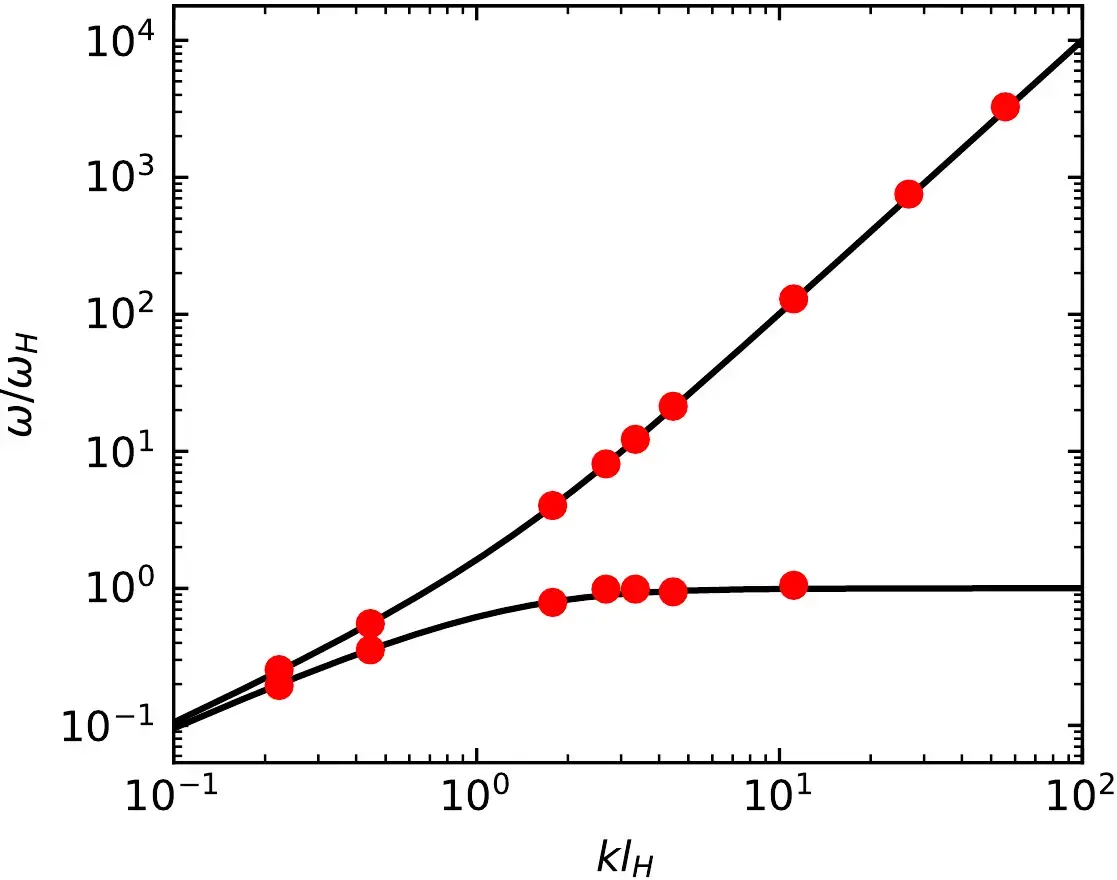
For a field along z, the Hall term splits Alfvén waves into a whistler and an ion-cyclotron wave with phase speeds
c = ±ηHk/2 + [ (ηHk/2)2 + vA2 ]1/2.
The whistler speed grows without bound with the wavenumber k, so grid-scale noise travels fastest, and explicit second-order schemes need some dissipation at small scales to remain stable. The Hall flux uses the same face gradients as paper I, with the time-step limit Δt = C Δx2 / (2d |ηH|).
To find out how much dissipation is needed, we simulated C-shocks with ηH = 0.02 |B|. The Hall term produces oscillations ahead of the shock whose damping measures the total resistivity, so fitting semi-analytic profiles reveals the numerical resistivity. Without explicit diffusion it decreases with resolution, and from 100 cells per unit length on the runs became unstable. With explicit Ohmic resistivity, instability appeared only below ηO/ηH ≈ 0.1.
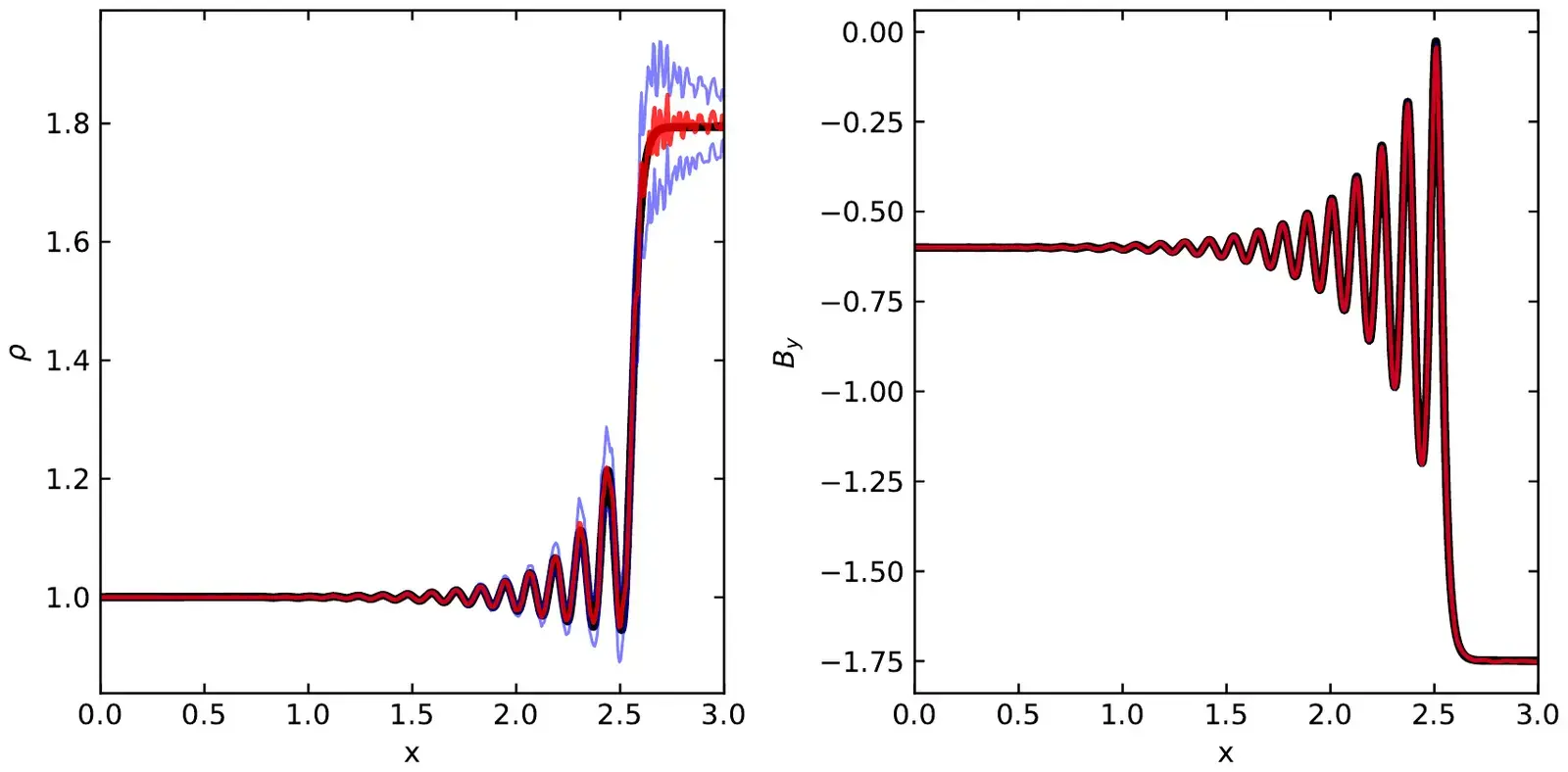
Rather than switching to a more diffusive Riemann solver everywhere, we raise the Ohmic resistivity locally, only where it is needed, so that |ηH| < 5 (ηO + ηA). This is a conservative margin over the measured threshold and was stable in all tests and collapse runs of the paper; the price is that strongly Hall-dominated regions are damped more than they should be. With sufficient Ohmic resistivity the C-shock converges to the semi-analytic solution at about second order, and with the condition in place the dispersion relation of whistler and ion-cyclotron waves is reproduced over more than two decades in klH.
For comparison we also implemented a Hall-modified HLL Riemann solver. Its damping grows as k4, which suppresses small-scale whistlers efficiently but also raises the numerical viscosity everywhere. Since the Hall effect may dominate only in small regions, while a forming disk is resolved by relatively few cells, we preferred the local fix.
Cloud-core collapse
Both papers test the solver on the collapse of a rotating, magnetized 1 M☉ sphere of radius 0.015 pc threaded by a uniform 107 μG field, with constant coefficients of 1018 cm2 s−1. After about 3.4 × 10⁴ years, the ideal-MHD run forms a roughly spherical core with fields above about 105 μG in its center and fast outflows, while Ohmic or ambipolar diffusion produces a more extended disk-like structure, weaker fields and slower outflows. With the Hall effect the result depends on its sign:
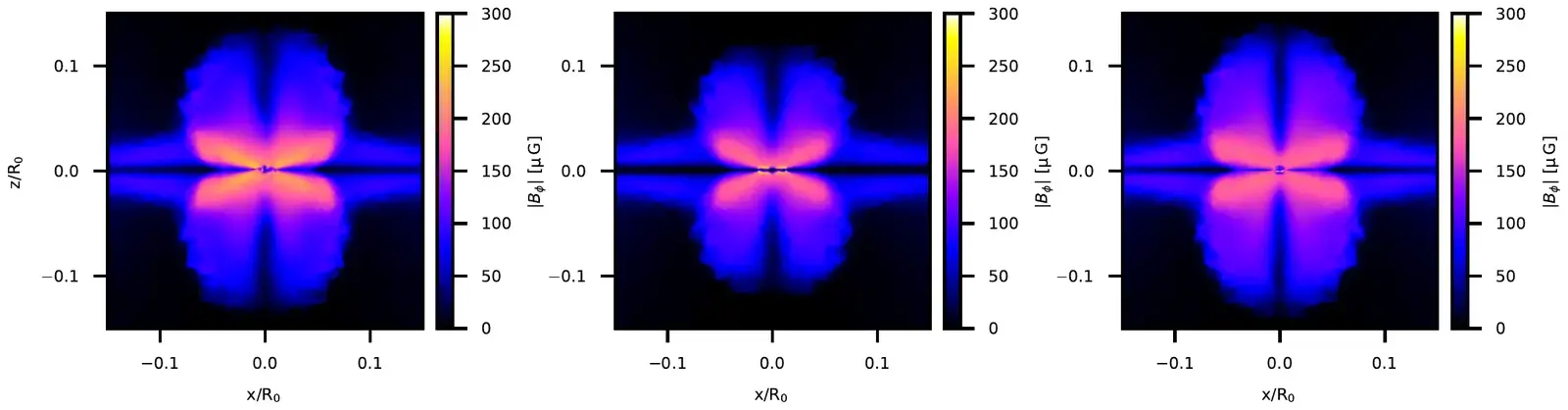
With a positive coefficient the Hall drift weakens the azimuthal field and magnetic braking, and the outflow is broader and slower; with a negative one both are enhanced and the outflow is faster and more collimated.
With Alexander Mayer, we then used chemistry-based coefficients. In isolated cores, angular momentum removal is significantly reduced relative to ideal MHD, and the Hall effect can enhance or suppress outflows depending on the field orientation (Mayer, Zier et al. 2025). In cores forming in a supernova-driven turbulent medium, ambipolar diffusion allows large disks in two of six cores, where ideal MHD allows none larger than 10 au (Mayer et al. 2025). With radiative transfer added, the field in the second Larson core reaches more than 105 G, and a jet faster than 10 km s−1 is launched (Mayer et al. 2026).
Papers
-
Non-ideal magnetohydrodynamics on a moving mesh I: Ohmic and ambipolar diffusion
Zier, Springel & Mayer · MNRAS 527, 1563–1579 · 2024
Paper I: the face-centered least-squares gradients, Ohmic and ambipolar fluxes, tests against ATHENA++, the linear MRI and a first collapse test.
-
Non-ideal magnetohydrodynamics on a moving mesh II: Hall effect
Zier, Mayer & Springel · MNRAS 527, 8355–8368 · 2024
Paper II: the Hall term, its instability at high resolution, the minimum-resistivity condition, whistler waves and the Hall bimodality in collapse.
-
Moving-mesh non-ideal magnetohydrodynamical simulations of the collapse of cloud cores to protostars
Mayer, Zier, Naab et al. · MNRAS 537, 379–401 · 2025
Collapse of cloud cores to protostars with all three non-ideal terms, several chemistry models and initial geometries.
-
Mayer, Naab, Caselli et al. · MNRAS 543, 3321–3344 · 2025
Disk formation in cores forming in a supernova-driven, magnetized interstellar medium.
-
Mayer, Pakmor, Naab et al. · MNRAS 545 · 2026
Radiation non-ideal MHD in AREPO and jet launching from the second Larson core.