Summary
- Simulations
- 14 zoom-ins
- high-redshift galaxies selected from the THESAN volume
- Best baryonic resolution
- 142 M⊙
- per cell, with a multi-phase model of the interstellar medium
- Radiation field
- From THESAN-1
- patchy, time-dependent field of the parent box instead of a uniform UV background
- Population III halos
- 106–109 M⊙
- form metal-free stars until the end of reionization near z = 5
- UV-field comparison
- 3 treatments
- seven zoom regions at 1140 M⊙ baryonic resolution
- Metallicity imprint
- Below 1010 M⊙
- halos stay less enriched after early reionization, at all simulated epochs (z > 3)
THESAN-ZOOM is a collaboration project. My two papers are Zier et al. 2025a on Population III stars and Zier et al. 2025b on external reionization.
The simulations
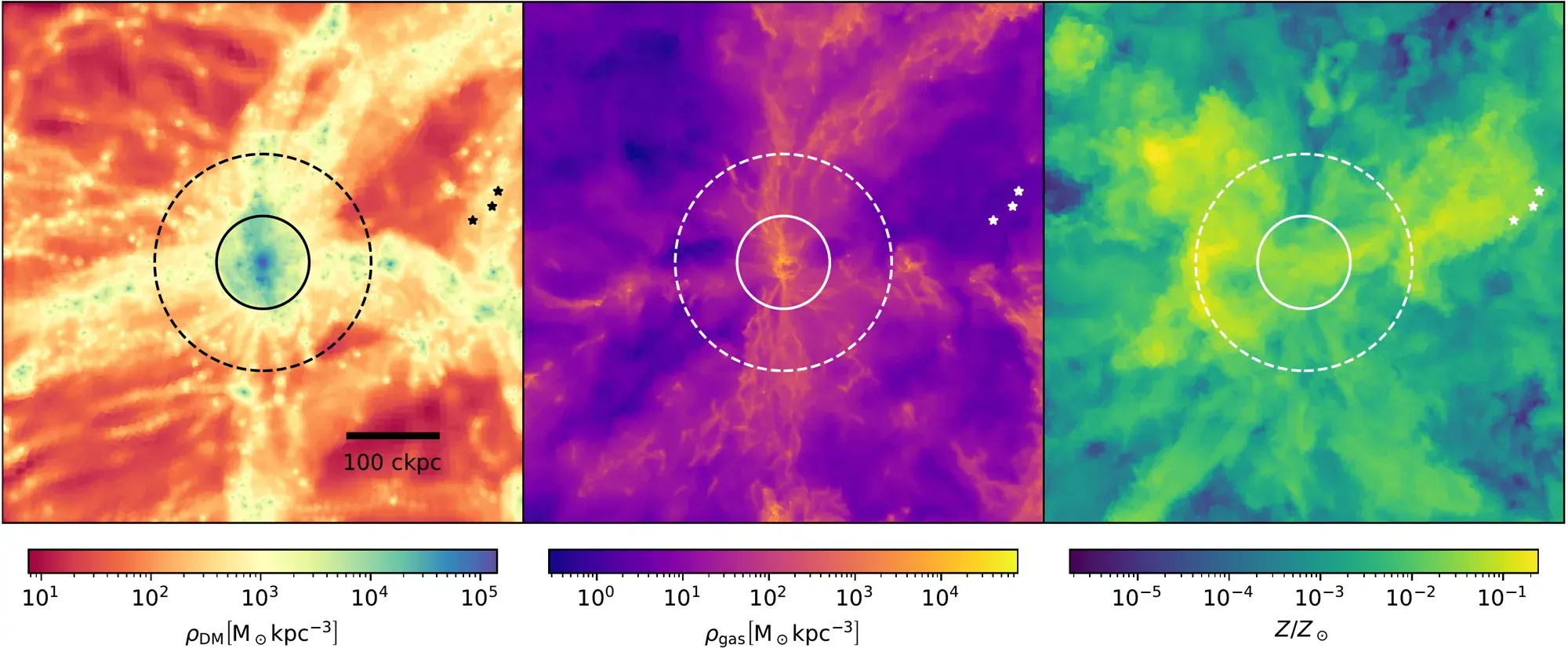
The suite consists of 14 zoom-in simulations of high-redshift galaxies selected from the THESAN volume. They reach a baryonic mass of 142 M⊙ per cell and use a multi-phase model of the interstellar medium. Instead of a uniform UV background, the zoom-in simulations use the large-scale radiation field from the parent THESAN box, so each region is reionized consistently with THESAN.
Population III star formation
Population III stars form from metal-free gas, and their formation rate is expected to drop sharply after z ≈ 15 as earlier generations enrich the gas. Using the 14 zoom-in simulations, with Lyman–Werner radiation and a non-equilibrium network that tracks molecular hydrogen, we found that Population III stars keep forming in halos of 106–109 M⊙ until the end of reionization near z = 5. Photoevaporation then halts star formation in these minihalos, and they merge into larger halos, so Population III remnants are found mainly in satellite galaxies at lower redshift.
External reionization
In the companion paper I compared three treatments of the external UV field in seven zoom regions at 1140 M⊙ baryonic resolution: a uniform background switched on at z = 10.6, the same background switched on at z = 5.5, and the default patchy field from THESAN-1.
- External UV radiation unbinds gas from halos below 109 M⊙ and suppresses their later star formation.
- With early reionization, minihalos fail to form stars from pristine gas, so the gas later accreted by more massive halos is less enriched. Halos below 1010 M⊙ then have lower metallicities at all simulated epochs (z > 3).
- Self-consistent shielding allows a cold, low-density gas phase to survive down to z = 3.
Models emulating metal enrichment in minihalos therefore require, at minimum, spatially inhomogeneous reionization and a non-uniform metallicity floor.
Papers
-
The THESAN-ZOOM project: Population III star formation continues until the end of reionization
Zier, Kannan, Smith et al. · MNRAS 544, 410–429 · 2025
Population III stars keep forming in halos of 10⁶–10⁹ solar masses until the end of reionization near z = 5.
-
The THESAN-ZOOM project: Long-term imprints of external reionization on galaxy evolution
Zier, Kannan, Smith et al. · MNRAS 544, 391–409 · 2025
How the treatment of the external UV field changes star formation and metal enrichment in halos below 10¹⁰ solar masses.
-
Kannan, Puchwein, Smith et al. · The Open Journal of Astrophysics 8, 153 · 2025
The THESAN-ZOOM suite: zoom-ins of z > 3 galaxies with a multi-phase ISM and the patchy radiation field of THESAN.
-
Summerfield, McClymont, Tacchella et al. · submitted to MNRAS · 2026
Diagnostics of ionizing-photon escape from more than 35,000 THESAN-ZOOM galaxy realizations.
The other THESAN-ZOOM papers I co-authored are in the publication list.